REVIEW · CAMBRIDGE
Scholars & Secrets of Cambridge: Self-Guided Puzzle Adventure
Book on Viator →Bookable on Viator
A puzzle route can make Cambridge feel new. This smartphone mystery nudges you from site to site with riddles and GPS, covering the city’s top college facades and famous landmarks. I like the offline, no-internet play, and I also like the flexible start-and-stop format that keeps it easy with kids or slower walkers. One drawback: you’re doing the guiding, so if you want someone talking history at you or you expect lots of indoor time, this may feel a bit light.
The best part is how it turns a straight walk into a game. You’ll solve a clue, arrive at a spot, then get the next instruction while learning what you’re looking at. If you like walking the River Cam area and spotting details at college gates and churches, this works well. If you’re hoping for a big “tour bus” feel or a deeper stop-by-stop lecture, you may want to pair it with a classic guided visit.
In This Review
- Key Points Before You Go
- Entering Cambridge Through a Smartphone Mystery
- Start Point: The Corpus Clock and Getting Your Bearings
- How the Puzzle Adventure Moves You (Without Needing Internet)
- The Cambridge Walk: What You’ll See at Each Stop
- Stop 1: Corpus Clock at Corpus Christi College
- Stop 2: King’s College Facade by the River
- Stop 3: Gonville and Caius College
- Stop 4: Clare College, Founded as University Hall
- Stop 5: Trinity College, the Largest by Undergraduates
- Stop 6: St John’s College and Lady Margaret Beaufort
- Stop 7: The Round Church Visitor Centre
- Stop 8: Christ’s College
- The Real Value: Free Admissions and a Compact Route
- Who This Suits Best (and Who Might Be Happier Elsewhere)
- Price and Logistics: Is $8.68 Really Fair?
- Should You Book Scholars & Secrets of Cambridge?
- FAQ
- Do I need an internet connection to play?
- How long does the adventure take?
- Where does the tour start and end?
- Is there a physical tour guide?
- Can I start at any time, or do I have to pick a specific slot?
- Is the experience private?
- Are the stops free to enter?
- What’s the cancellation policy?
- Are the sights you visit indoors or outdoors?
Key Points Before You Go
- Offline-ready: you don’t need internet to play the game
- Self-paced timing: start whenever you want, pause, then resume later
- Private for your group: only your party plays the adventure
- Outdoor-focused stops: you’ll mainly view college and church exteriors
- Campus highlights on foot: Corpus Christi, King’s College, Trinity, and more
- Street-level anchor: begin at the Corpus Clock and walk a compact loop
Entering Cambridge Through a Smartphone Mystery
Cambridge has a way of making you slow down. Stone buildings, gatehouses, and river views all beg for a closer look. This experience takes that instinct and adds a story: a secret society theme that uses riddles to get you moving to the next location.
Instead of checking a list of “must-sees,” you follow clues. The game uses GPS location prompts so you’re not guessing where to go next. When you reach a stop, you get the next instruction and a bit of context about the place you just found. That structure is great if you’re visiting once and want a smart way to cover a lot without feeling rushed.
It also helps that this is a self-guided activity—no physical tour guide. That’s a real plus for families (and anyone who hates waiting). You can spend extra minutes at a detail you like, then skip ahead when you’re ready.
Here’s the small consideration I’d plan for: because it’s smartphone-led, clarity matters. If you’re the kind of visitor who wants a person explaining what you’re seeing right now, you may not get that from this format. On the flip side, if you’re the type who enjoys figuring things out on foot, you’ll probably grin.
You can also read our reviews of more guided tours in Cambridge



Start Point: The Corpus Clock and Getting Your Bearings
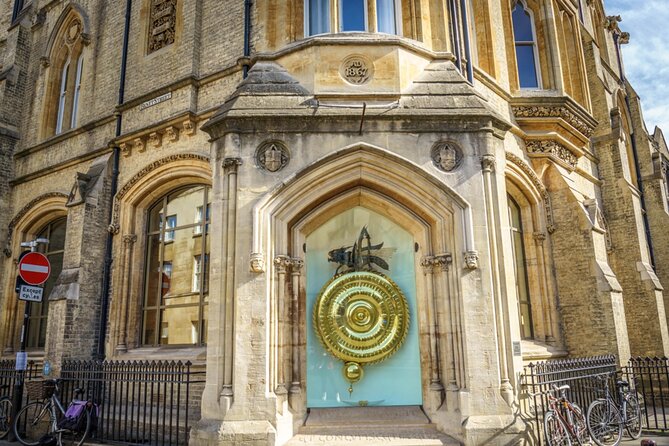
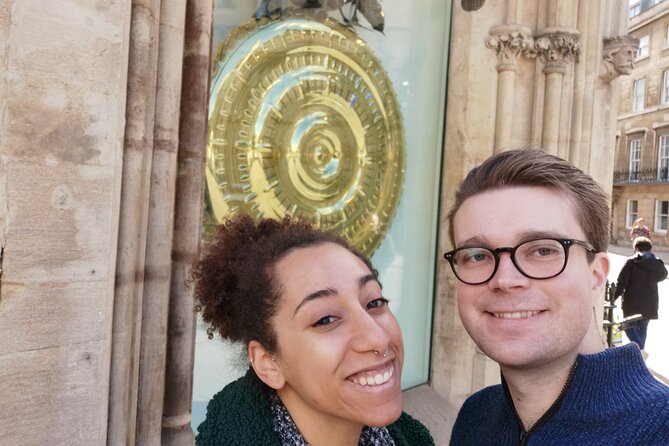
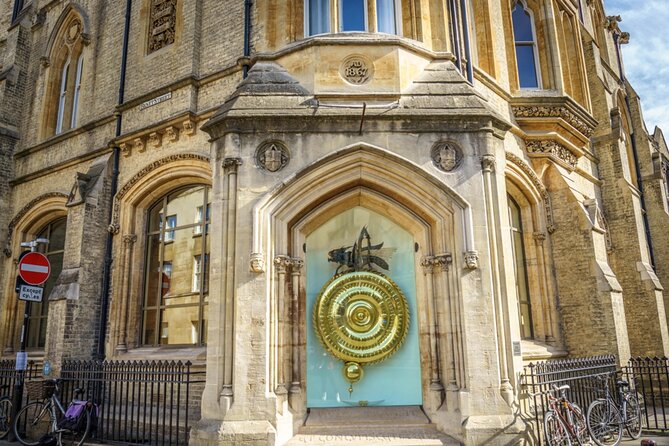
The adventure begins at the Corpus Clock, at 58 Trumpington St, Cambridge CB2 1RH. It’s an excellent start because it’s visible and easy to use as a landmark before you head into the college-studded center.
The “how long” part is also friendly: you’re looking at roughly 1 to 2 hours. The game is built around short visits—many stops are around 5 to 10 minutes—so you’re not committing to a marathon.
About timing: the information provided shows the activity operating daily during 8:00 AM to 9:00 PM for the date range listed. At the same time, it also states the tour is available 24/7 and you can start at any hour. In practice, I’d treat the 8:00 AM–9:00 PM window as the times you’ll most comfortably be walking and spotting sights, while the “24/7 availability” means you’re not stuck with a narrow booking schedule.
If you’re visiting in warm weather, bring a water bottle and plan for a lot of standing around gates and facades. If you’re visiting in cooler months, dress for wind off the river—Cambridge can get breezy in a hurry.
How the Puzzle Adventure Moves You (Without Needing Internet)
This is where the experience earns its keep. The game is designed so you can play offline, meaning you don’t need mobile data for it to function. That matters in Cambridge, where reception can be spotty on some side streets.
The flow is simple:
- You locate the current spot via your phone.
- You solve a clue/puzzle to determine the next stop.
- You arrive, then the game gives you the next set of instructions while teaching you what you’re seeing.
GPS + riddles can be a great mix because it stops the walk from feeling like “just wandering.” You still get freedom to move at your pace, but the game keeps the route intentional.
Practical tip: if your phone GPS seems a bit jumpy (common near stone walls), take a few steps—don’t freeze in place. Cambridge’s streets can be narrow, and the best signal often comes from standing slightly away from tall surfaces.
Another practical point: since it’s designed for a group format where only your group participates, it’s not dependent on other people’s pace. That’s good if your group has mixed interests, like one person who wants the story clues and another who just wants to admire architecture.
The Cambridge Walk: What You’ll See at Each Stop

This route is a quick sampler of Cambridge’s most famous college frontages and a classic church. Expect a lot of “street-level viewing”—you’ll be close enough for photos and details, but not treated like you’re entering a major attraction building at every stop.
Stop 1: Corpus Clock at Corpus Christi College
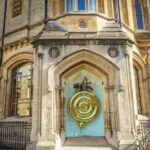
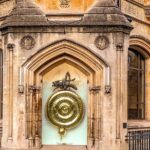
Your first big landmark is the Corpus Clock, a large sculptural clock at street level outside the Taylor Library at Corpus Christi College. It’s a smart opener because it’s immediately visually interesting, and it anchors the whole game in one clear meeting place.
What I’d do here: spend those first minutes looking up and around the clock instead of rushing into the next clue. It’s the kind of landmark where the details are part of the charm.
You can also read our reviews of more tours and experiences in Cambridge




Stop 2: King’s College Facade by the River
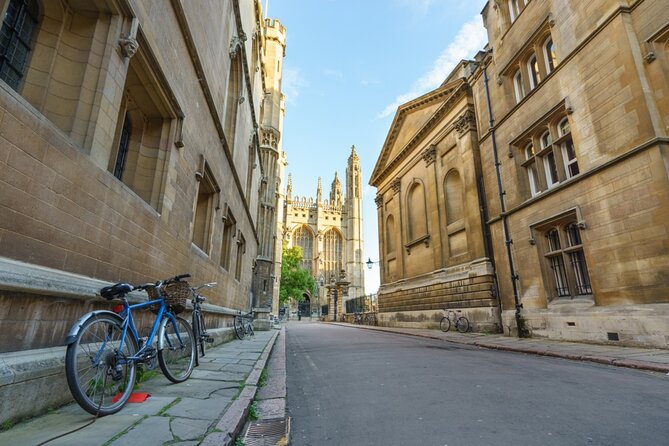
Next comes King’s College, a constituent college of the University of Cambridge, sitting beside the River Cam and facing King’s Parade. Even if you’re not going inside (and the game keeps it outdoor-focused), the setting gives you that “Cambridge postcard” feeling fast.
This stop is also useful because it gives you orientation: after King’s College, the rest of the college names and areas start to feel connected instead of random.
Stop 3: Gonville and Caius College
At Gonville & Caius College, you’re looking at one of Cambridge’s older institutions. The key detail here is that it’s the fourth-oldest college at the University. That kind of fact is exactly the sort of nugget a puzzle game does well—it’s not just a plaque moment, it becomes tied to movement.
If you like architectural subtleties (gate styles, brick patterns, windows), this is a good pause-and-look stop.
Stop 4: Clare College, Founded as University Hall
Then you reach Clare College, founded in 1326 as University Hall. It’s described as the second-oldest surviving college after Peterhouse. That’s a strong “Cambridge context” stop, and it explains why these buildings feel so established and permanent.
A small drawback to expect: because this is focused on exterior viewing, you may not get the full sense of a college’s interior spaces. If you specifically want interior rooms and guided access, you’ll likely need a separate visit.
Stop 5: Trinity College, the Largest by Undergraduates
The game moves you to Trinity College, noted as the largest college in either of Oxbridge universities by the number of undergraduates. That’s a fun detail because you can connect the name Trinity with how substantial the college is today, not just how old it is.
This is also a great photo moment. Even a quick stop gives you a sense of scale—Trinity’s presence is hard to miss.
Stop 6: St John’s College and Lady Margaret Beaufort
Next is St John’s College, founded by Lady Margaret Beaufort. That specific founder detail is the kind of fact that makes Cambridge feel human, not just old stone.
If you enjoy trivia that actually points to something real (like why a name matters), this is a good stop. If you’re purely in “walk and relax” mode, you can still enjoy the architecture without needing to memorize everything.
Stop 7: The Round Church Visitor Centre
Then you shift from colleges to a church: the Round Church Visitor Centre, connected with The Church of the Holy Sepulchre, generally known as The Round Church. It’s an Anglican church and the distinctive round form helps it stand out as a contrast to the college buildings.
This is a smart mid-route change of pace. After multiple college facades, a different type of landmark gives your feet and brain a reset.
Stop 8: Christ’s College
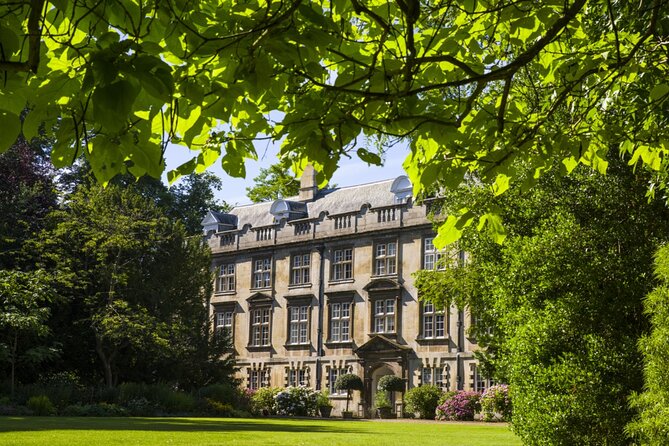
The final college stop is Christ’s College. It’s listed simply as a constituent college, so the emphasis here is on the walk itself—tying the route into a satisfying “end cap” near the center.
Once you finish Christ’s College, the game ends back at the starting point. That makes planning simple: you know where to return without hunting.
The Real Value: Free Admissions and a Compact Route
The itinerary stops are listed as free admission. That’s a big part of the value equation. You’re paying for the experience design (the GPS-driven puzzle format and storytelling), not for entry tickets.
At $8.68 per person and 1–2 hours long, it’s a budget-friendly way to cover the big names you’ll see on every Cambridge itinerary. And because the stops are outdoor-focused, you avoid a common travel frustration: standing in line for entries that don’t match your timing.
Still, this route is compact. One reason a few people find puzzle walks dull is when the steps feel too short or too close together. Here, the total time is part of the bargain. You’re not getting a whole day of Cambridge. You’re getting a focused sampler with a game wrapper.
Who This Suits Best (and Who Might Be Happier Elsewhere)
This experience is especially suited to:
- First-time visitors who want a quick orientation to Cambridge’s college core
- Families who want movement plus story without the pressure of a lecture
- People who like puzzles and don’t mind reading their phone to keep going
- Anyone who wants to avoid crowds and keep control of pacing, since it’s private and group-only
It may be less ideal if:
- You want extensive interior access to colleges or churches. The experience is set up so the quests are outdoors.
- You dislike smartphone instructions or prefer a person guiding you step-by-step.
- Your group expects a long, detailed museum-style narrative at each stop. This is more “walk with questions” than “guided deep explanations.”
Price and Logistics: Is $8.68 Really Fair?
For many self-guided city games, the cost buys convenience: offline play, a planned route, and the structure that turns wandering into something you can finish. Here, you’re also getting free admission at the listed sites, plus the promise that it’s private and you can start whenever your schedule allows.
If you’re traveling as a family or small group, the “only your group” factor matters. You avoid the awkward mismatch when one person wants slow photo time and another wants to sprint to the next stop. The game’s design helps you keep your group together without waiting on strangers.
I also appreciate the safety angle implied by the design: it’s described as private with no human contact, and that matters if you’re trying to keep your travel plans low-fuss. Just remember: “no guide” also means you own the navigation. Bring a charged phone and a comfortable pair of shoes.
Should You Book Scholars & Secrets of Cambridge?
If you want a low-cost, outdoor-focused way to hit key Cambridge sights in about an hour or two, I think it’s an easy yes. The offline smartphone puzzle, the compact college loop, and the secret society story hook make it a fun alternative to a straight list of attractions.
I’d pass or at least temper expectations if you’re shopping for deep access, indoor tours, or a chatty live guide. This is built for walking, solving, and spotting architecture from the street.
If you’re the type who likes to figure things out as you go, this one is worth booking—especially on a day when you want to see a lot without spending a lot.
FAQ
Do I need an internet connection to play?
No. The experience is designed so you can play offline, so you don’t need internet to run the game.
How long does the adventure take?
It takes about 1 to 2 hours.
Where does the tour start and end?
It starts at the Corpus Clock, 58 Trumpington St, Cambridge CB2 1RH, UK and ends back at the meeting point.
Is there a physical tour guide?
No. This is a self-guided smartphone experience with no physical tour guide.
Can I start at any time, or do I have to pick a specific slot?
The experience is described as available 24/7 and you can start at any hour, with listed opening hours shown as 8:00 AM to 9:00 PM for the date range provided.
Is the experience private?
Yes. It’s a private activity, and only your group participates.
Are the stops free to enter?
The stops listed have free admission.
What’s the cancellation policy?
You can cancel for a full refund up to 24 hours in advance. If you cancel less than 24 hours before the start time, the amount paid is not refunded.
Are the sights you visit indoors or outdoors?
The quests are set up to be outdoor sightseeing, meaning you’ll mainly view the exteriors from outside.
If you want, tell me your travel dates and whether you’re going with kids or another group. I can suggest the best time of day to run this route in a calm, photo-friendly window.