REVIEW · FREEDOM TRAIL TOURS
Freedom Trail Walking Tour 250
Book on Viator →Operated by Tour of the Freedom Trail · Bookable on Viator
Colonial Boston comes to life fast on this walk. I love the in-character guide and the way the stories connect Founding Fathers to real corners you can actually see. I also like that it’s a short 1.2-mile route that works for a wide range of people. One watch-out: depending on the guide, the balance between humor and history can feel uneven, and the walk can get crowded at popular stops.
This Freedom Trail tour hits the highlights without dragging. You’ll cover key landmarks tied to the Revolution, including churches, schools, meeting houses, and major public squares, all in about 1 hour 45 minutes. If you want to get your bearings fast while learning what mattered to early Bostonians, this format is a good fit.
In This Review
- Key highlights to look for on this Freedom Trail tour
- A 1.2-Mile Freedom Trail Sprint Through Colonial Boston
- Costumed Guides and the Stories That Actually Stick
- Starting at the Massachusetts State House: Power in Plain Sight
- Park Street Church: A Hymn Connection You Can Hear
- Granary Burying Ground: Final Resting Places With Revolution Echoes
- King’s Chapel and Boston Latin School: Religion and Public Learning
- Old Corner Bookstore: The Printing Press Era Comes Alive
- Old South Meeting House: The Tea Party Moment, Ticket Note Included
- Boston’s Oldest Standing Government Building and the Street-Level Power
- Boston Massacre Site and the Protest That Became a Battle Cry
- Faneuil Hall Marketplace: Public Speech, Real Energy
- Bonus Visual Stop: The Paul Revere House Built in 1680
- How Crowds and Hearing Work During This Short Tour
- Price and Value: What $26 Buys You for 1 Hour 45
- Should You Book This Freedom Trail Walking Tour 250?
- FAQ
- How long is the Freedom Trail Walking Tour 250?
- What does the tour cost?
- Is the tour offered in English?
- How far do you walk during the tour?
- Where does the tour begin?
- Is admission included for all stops?
- Do I get a mobile ticket?
- Does the tour run in bad weather?
- Can I cancel for free?
Key highlights to look for on this Freedom Trail tour
- Costumed, in-character storytelling that aims to make the era feel personal
- A tight 1.2-mile loop (about 2 km) that most people can handle
- Landmarks that are mostly free to view, with one stop that may require your own ticket
- Lots of famous names in short bursts, from church music history to Benjamin Franklin
- A group capped at 50 people on paper, so you can hear your guide
A 1.2-Mile Freedom Trail Sprint Through Colonial Boston

Think of this as a guided walk through colonial-era Boston that doesn’t eat your whole day. The route is about 1.2 miles (2 km) and runs about 1 hour 45 minutes. That’s long enough to connect the dots, but short enough that you’re not stuck in transit all afternoon.
The pacing matters here. Reviews and the tour’s format point to a walk that’s not overly strenuous, and the stops are fairly close together. Still, Boston’s core sites can be busy, so plan on a bit of jostling when multiple groups gather at the same landmark.
Also note the start approach: the tour begins at the Current Massachusetts State House, then moves you through a sequence of churches, burial grounds, schools, and public meeting places. The whole point is that you’re walking the story, not just standing in one museum room.
You can also read our reviews of more walking tours in Boston

Costumed Guides and the Stories That Actually Stick
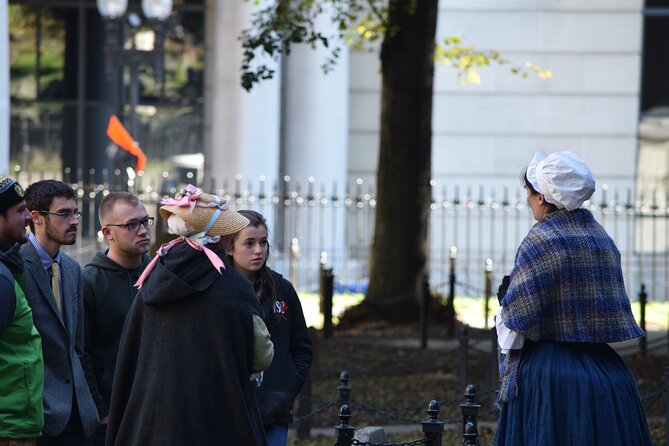
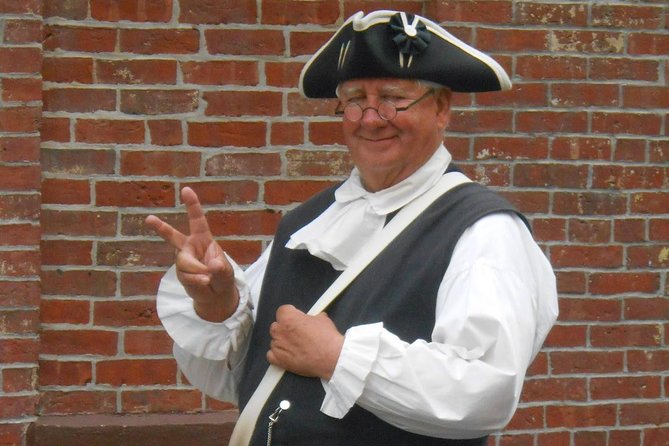
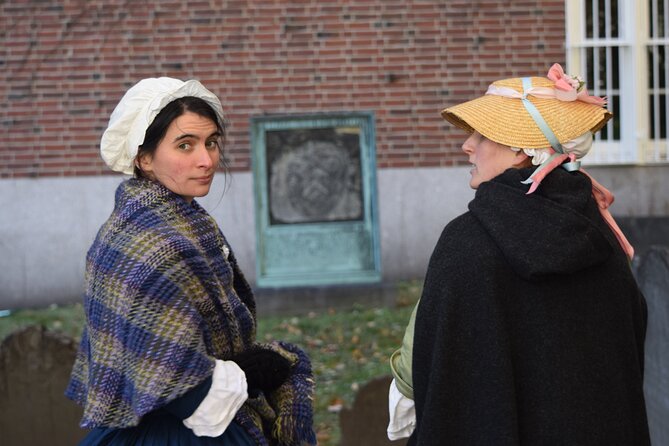
The biggest draw is the guide performance. This isn’t a silent history lesson. You’ll hear stories delivered by a guide in costume and staying in character, with emphasis on the Revolution, New England’s colonial period, and the Founding Fathers.
What I like about this style is that it gives you a mental hook for each location. Instead of memorizing dates, you remember scenes: a church tied to early American hymn history, a burial ground that puts the Revolution in personal terms, and meeting houses tied to the Tea Party moment.
That said, style is not the same as accuracy. One caution from real departures: when the guide leans too hard on comedy or informal nicknames, some people feel the history takes a hit. If you want strict, careful storytelling with lots of factual grounding, you’ll want to be prepared to judge the guide quickly once the tour starts.
A bright note: some guides are repeatedly described as strong at pacing and holding attention, including in colder weather. Names that come up often include Ben, Elizabeth, Elaina (listed as Elaina Jacobs), Catherine, Mark, Jeremiah Poope, and Mrs. Palmer—and if you see a chance to request a specific performer, it can make a real difference.
Starting at the Massachusetts State House: Power in Plain Sight
You kick off at the Current Massachusetts State House. Even if you don’t go inside, it’s a smart opening because it frames what you’re about to learn: Boston’s colonial energy eventually feeds into public leadership and the kinds of political change people fought for.
Use this first stop as your warm-up. Watch how the streets funnel toward the sites you’ll hit next, and get ready for the pattern of the Freedom Trail idea: walk, notice, listen, repeat.
If you’re the type who likes a quick overview before you go finer-grained, this beginning works well. You’ll set expectations early, then the guide can “zoom in” as the walk continues.
Park Street Church: A Hymn Connection You Can Hear
Next up is Park Street Church, where the hymn My Country ’Tis of Thee was first performed. This is one of those stops that feels small on the map but big in meaning. Music traveled faster than pamphlets, and early American identity often spread through shared songs.
You’ll likely spend only a few minutes here—about 5 minutes. That brevity is good because it keeps the tour moving. Still, stand where you can listen. With crowds, the “best spot” can shift fast, and this is the kind of place where you’ll want your eyes forward, not down at a phone.
This stop is also a good checkpoint for the tour quality. If the guide is clear and organized here, chances are the rest of the walk will flow better.
Granary Burying Ground: Final Resting Places With Revolution Echoes

The tour then heads to Granary Burying Ground, one of Boston’s major story sites. You’ll spend about 20 minutes, and this is the longest single stop—so it can shape your overall experience.
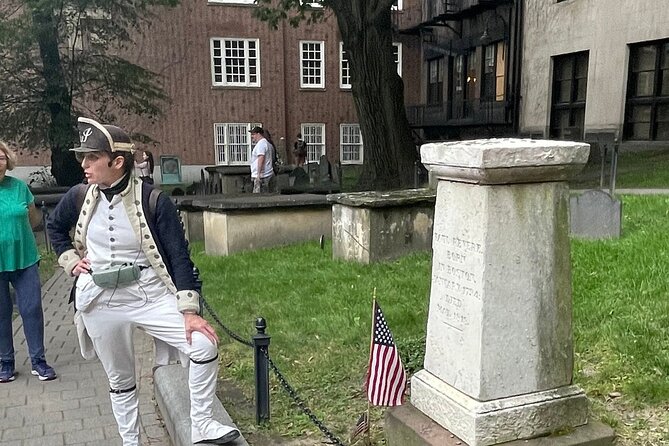
This is where you hear the inspiring stories tied to America’s Founding Fathers at their final resting place. The emotional weight is real, and the guide’s performance style matters here. If your guide stays respectful while explaining context, you’ll come away with a stronger sense of why people risked everything.
Potential drawback: some people feel too much time in this cemetery can slow the tour if you’re expecting more walking. If you’re short on patience for long pauses, keep your energy up and prepare to take it in chunks—listen first, then look around second.






King’s Chapel and Boston Latin School: Religion and Public Learning
From the burial ground, the tour moves to King’s Chapel, described as America’s first Anglican church. That’s a quick stop (around 5 minutes), but it adds a useful angle: colonial Boston wasn’t one single viewpoint. It was a mix of communities, traditions, and competing beliefs that shaped public life.
Then you hit Boston Latin School, touted as America’s first public school. Even if you don’t go far in the building, the idea matters. A school like this signaled that civic life depended on education and institutions that outlasted any single leader.
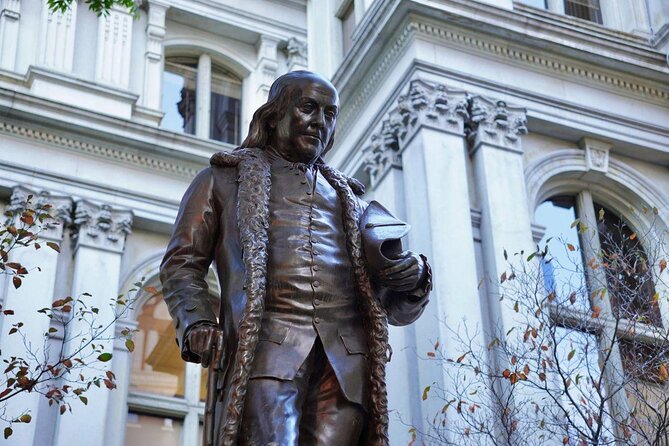
Right nearby, you’ll also spend time at the Statue of Benjamin Franklin. Franklin can feel like a schoolbook name until someone connects him to the city and the school’s alumni path. This tour tries to do exactly that—placing famous figures into specific Boston settings.
Old Corner Bookstore: The Printing Press Era Comes Alive
The Old Corner Bookstore is another short stop (about 5 minutes). It’s described as America’s oldest commercial building, and the tour ties it to publication history—specifically Midnight Ride of Paul Revere.
This is a great reminder that revolutions don’t just happen in fields. They happen on paper and in headlines. When the guide links a building to how stories spread, the place stops being a facade and starts feeling like an engine.
Practical tip: at quick stops, you’ll learn more if you keep your listening position stable. Don’t pace around looking for photos. Pick a spot you can hear from, then take photos after the guide’s main story hits.
Old South Meeting House: The Tea Party Moment, Ticket Note Included
Next is Old South Meeting House, where it happened with the Boston Tea Party (about 10 minutes). This is one of the headline Revolutionary War stops on the route.
One important detail: admission here is not included. So if the guide encourages you to go inside, you’ll need to plan for your own ticket. If you’re trying to keep costs predictable, you might want to decide in advance whether you’ll pay to enter or focus on the exterior context and the story portion.
This is also a place where crowds can thicken quickly. If you struggle to hear, position yourself early and don’t let bigger groups walk into your line of sight.
Boston’s Oldest Standing Government Building and the Street-Level Power
The tour includes a stop for Boston’s oldest standing government building. Even without digging into exact interior details, the idea is clear: you’re seeing the physical “seat” of authority that early Bostonians lived under and fought against.
This stop works best if you treat it like a hinge. By now, you’ve heard about institutions (church, school, printing), and now you’re landing on government itself. The guide’s job is to connect how everyday civic spaces turned into political pressure points.
If your guide is strong, you’ll notice that the story tightens here. If they’re rushing, it can feel like one more stop. Either way, it’s worth looking up and taking in the building scale compared to the narrow streets around it.
Boston Massacre Site and the Protest That Became a Battle Cry
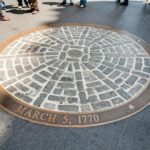
Then you arrive at the Boston Massacre Site, another 10-minute stop. This is where the tour frames the massacre and protest as part of the rise in Revolutionary momentum.
This kind of site can be intense even when you’re outside. The guide’s tone matters: you want context, not exaggeration. When the guide explains cause and effect—why it turned into a battle cry—you’ll come away with a more realistic picture of how conflict escalated.
Also keep an ear out for the guide’s added stories about Sam Adams. This tour name-checks him as part of the Revolution thread, and it’s helpful because Adams connects activism to organized resistance rather than leaving it as an abstract “people got angry.”
Faneuil Hall Marketplace: Public Speech, Real Energy
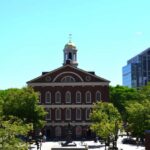
The last big named stop is Faneuil Hall Marketplace. You spend about 5 minutes, and the vibe is different from the darker corners like cemeteries and protest sites. This is about public voice and gathering—where citizens argued, organized, and built momentum.
Even in a short time, you can feel why this place matters. It’s the type of location where a guide’s storytelling can “land” because the space itself still looks built for crowds and debate.
If you’re trying to shop or eat nearby after the tour, plan it for right after you finish. This area makes it easy to pivot from history to lunch without long transit.
Bonus Visual Stop: The Paul Revere House Built in 1680
One extra feature in the route description is the Paul Revere House, noted as built in 1680 and described as Boston’s oldest residential building. Even if you don’t go inside, seeing the exterior context can help you understand how “close to home” Revolutionary stories were.
This works well for people who want history anchored in normal streets and normal buildings, not only in monuments. It’s the reminder that the Revolution wasn’t staged in some far-off place—it was woven into daily life.
How Crowds and Hearing Work During This Short Tour
You’ll cover a tight chain of stops, and that means you’ll often compete for space with other groups. The good news is the route is short enough that you’re not stuck in chaos for hours.
A few practical things I’d do to make it work:
- Wear comfortable walking shoes. Even easy distances feel long when you’re stopping often.
- Pick your “listening spot” at each stop. Then take photos after the story, not during the story.
- If you’re with kids, keep them near you for the best hearing. The performance style works well for younger attention spans when the guide can keep them engaged.
Group size is capped at 50 people, but crowds still build at popular landmarks. If you want the smoothest experience, choose a start time that avoids peak midday rush.
Price and Value: What $26 Buys You for 1 Hour 45
At $26 per person, the value comes from three things:
- A professional guide doing the heavy lifting of connecting sites to stories.
- A route packed with major landmarks in about 1 hour 45 minutes.
- Many of the stops are free to view, which keeps your out-of-pocket costs predictable.
Most listed stops are free admission, and the route emphasizes historical interpretation rather than expensive entry tickets everywhere. The one notable exception is Old South Meeting House, where admission is not included.
So you’re mostly paying for guided time, storytelling, and route management over a compact distance. That makes sense if you like learning while walking and you want fewer “what am I looking at?” moments than you’d get with solo self-guided wandering.
If you’re the type who prefers reading plaques alone and staying flexible, you might decide to self-walk the Freedom Trail. But if you want names, context, and a living narrative tied to real streets, this price feels fair.
Should You Book This Freedom Trail Walking Tour 250?
Book it if you want a guided shortcut to Boston’s colonial core. It’s a strong choice for first-time visitors who want Founding Fathers storytelling, quick stops you can actually remember, and a walk that stays manageable.
Skip or be cautious if you’re very sensitive to comedy style mixed with history, or if you hate crowds and long pauses at any single stop. In particular, cemetery stops can feel like a lot if you’re expecting more motion the whole time.
If you can, put effort into picking a guide name you’ve heard good things about, such as Ben, Elizabeth, Elaina, Catherine, Mark, or Jeremiah Poope. When the guide nails the tone and pacing, the tour becomes one of the best ways to understand why Boston became Boston.
FAQ
How long is the Freedom Trail Walking Tour 250?
It runs for about 1 hour 45 minutes (approx.).
What does the tour cost?
The price is $26.00 per person.
Is the tour offered in English?
Yes. The tour is offered in English.
How far do you walk during the tour?
The route covers approximately 1.2 miles (about 2 kilometers).
Where does the tour begin?
It begins at the Current Massachusetts State House.
Is admission included for all stops?
Most stops list free admission, but Old South Meeting House has admission not included.
Do I get a mobile ticket?
Yes. The tour uses a mobile ticket.
Does the tour run in bad weather?
It operates in all weather conditions, and you should dress appropriately. If it’s canceled due to poor weather, you’ll be offered a different date or a full refund.
Can I cancel for free?
Yes, there is free cancellation. You can cancel up to 24 hours in advance for a full refund.