REVIEW · FREEDOM TRAIL TOURS
Boston: Freedom Trail History Small Group Walking Tour
Book on Viator →Operated by Hub Town Tours · Bookable on Viator
Revolution-era Boston, footstep by footstep. This small-group Freedom Trail tour threads together all 16 official landmarks while your historian guide keeps the story anchored to 1760–1775, not random stops. I also like the built-in Q&A at each point, because you can ask the real why-things-happened questions as you go.
One possible drawback: it’s a walking tour through downtown and the North End, and you should plan on standing for long stretches. On cold or rainy days, you’ll want to dress for weather since the experience runs mostly outdoors, with limited time for going inside buildings.
In This Review
- Key Things I’d Prioritize
- Revolution on the Freedom Trail: What This 2.5-Hour Walk Really Covers
- Start at Boston Common, Finish at Copp’s Hill Terrace
- Boston Common to Granary Burying Ground: The Setting for Revolution Tension
- Franklin, Schools, Meeting Houses, and Tea Party Origins
- Boston Massacre to Faneuil Hall: When Politics Turned Dangerous
- North Square and the Paul Revere Stops: How Warnings Traveled
- Copp’s Hill Terrace Views: USS Constitution and Bunker Hill Across the Water
- Price and Value for $35.10: What You’re Paying For
- Who This Tour Fits Best (and Who Might Want a Different Plan)
- Should You Book This Freedom Trail Tour?
- FAQ
- How long is the Boston Freedom Trail History walking tour?
- How much does the tour cost?
- What does the tour include?
- Where do I meet the guide?
- Where does the tour end?
- What languages is the tour offered in?
- What topics does the historian guide focus on?
- Is the tour wheelchair and stroller accessible?
- Are museums or indoor admissions included?
- What happens if the weather is poor?
- Can I cancel for a full refund?
Key Things I’d Prioritize
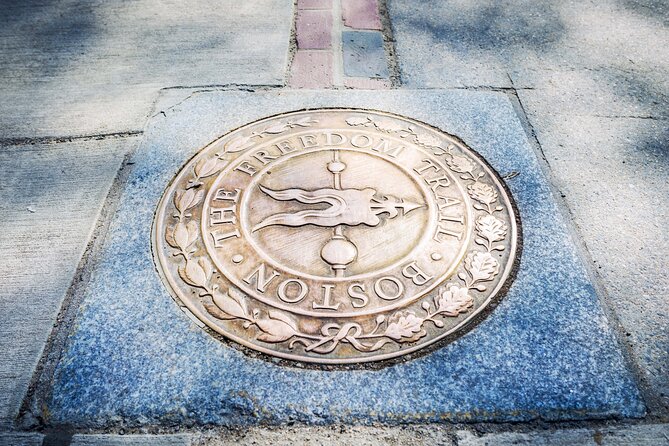
- All 16 official Freedom Trail stops in about 2.5 hours, end-to-end along the core route.
- 1760–1775 focus so you’re tracking the Revolution years instead of bouncing across centuries without context.
- Small group size (max 16) which makes questions easier and helps the pace stay human.
- Storytelling at major turning points like the Boston Massacre Site and Faneuil Hall.
- Guides who handle Q&A well, with examples like Jon’s chronological storytelling and Krista’s fast, clear answers.
- A satisfying finish on Copp’s Hill with views toward the Charles River landmarks and easy access to Hanover Street.
Revolution on the Freedom Trail: What This 2.5-Hour Walk Really Covers
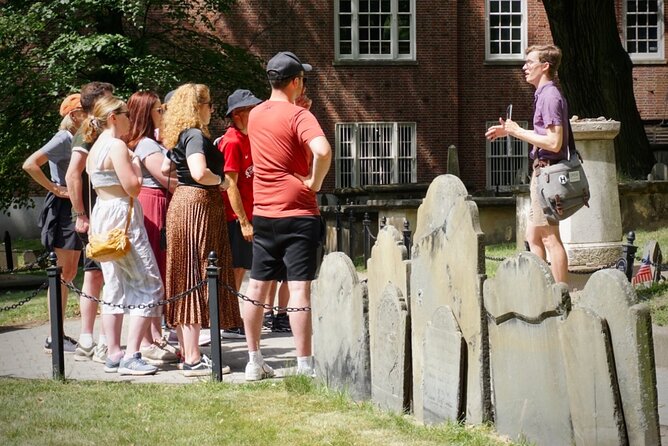
This tour is built for people who want Boston’s Revolutionary story in a straight line. You’ll walk the Freedom Trail and get context for the years 1760–1775, when the colonies went from political argument to open confrontation.
It helps that the guide is a historian, not just a person reading placards. If you’re the type who wonders what caused the tea to become a protest, or why violence followed policy disputes, this format is made for that.
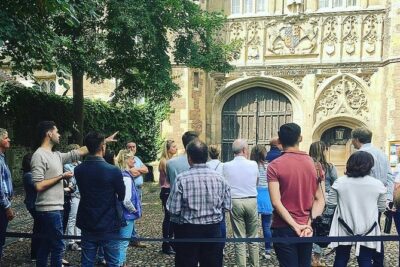
And because it’s a small group (up to 16), you’re not stuck watching one guide perform at the front. You can ask questions while you’re standing at the exact site where the story starts to make sense.
You can also read our reviews of more walking tours in Boston

Start at Boston Common, Finish at Copp’s Hill Terrace
You meet at the Boston Foundation Monument inside Boston Common, at 49 Beacon St (north boundary of the park, opposite 50 Beacon Street). Once everyone checks in, the group heads out in a logical route that keeps you moving through key central Boston sights.
The tour ends at Copp’s Hill Terrace, 520 Commercial St, overlooking the Charles River. From there, you get a visual sense of scale—especially with the freedom-trail landmarks across the water—plus the practical bonus of being close to Hanover Street’s food options.
One more small detail that matters: the tour includes a mobile ticket, so you’re not juggling paper while you’re navigating city blocks.
Boston Common to Granary Burying Ground: The Setting for Revolution Tension
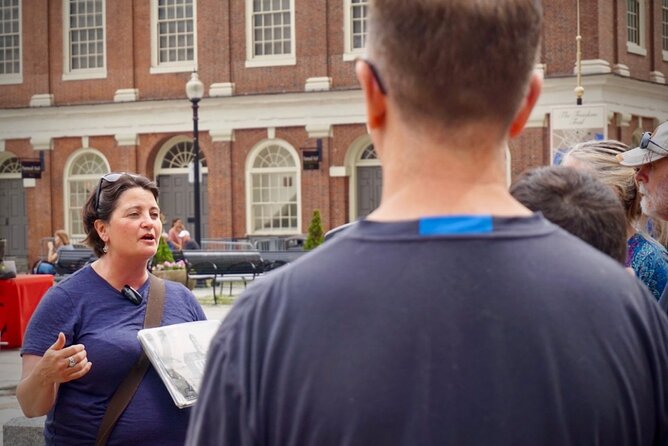
The tour starts with the Boston Foundation Monument in Boston Common, with a bronze relief tied to the Puritans arriving in 1630. It’s a quick opener, but it matters because it anchors the story in the place where Boston’s community life took shape long before the Revolution years.
Then you settle into Boston Common itself, described as the oldest public land in the Americas and Boston’s shared grazing pasture (dating to 1634). Standing there, you can feel how the center of civic life became the center of political conflict.
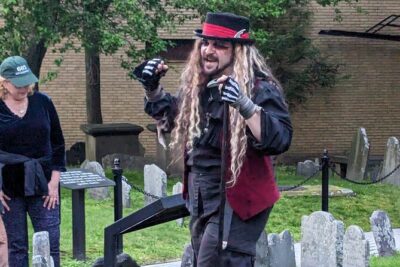
Next is the Granary Burying Ground, Boston’s third-oldest burying ground and a final resting place for Revolutionary-era Bostonians. Burial grounds can feel heavy, but on the Freedom Trail they work like history’s “before and after” chapters—people whose lives were tied to the events you’re about to hear.
What to watch for here: these sites explain why the Revolution was personal and local, not just a distant political drama. Even if you’ve read the basics, the guide’s framing helps the chain of events click.
Franklin, Schools, Meeting Houses, and Tea Party Origins
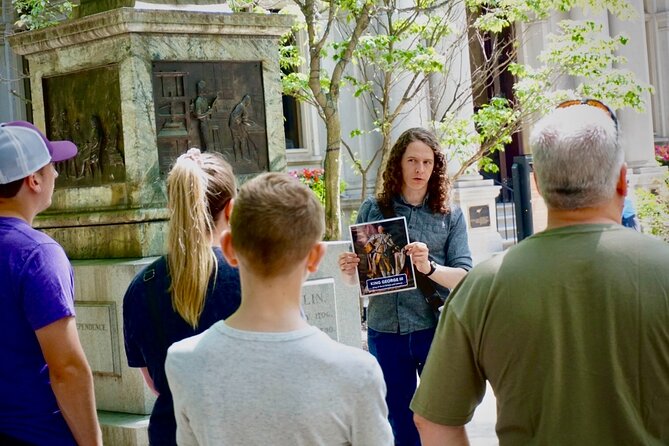
The route continues toward the Statue of Benjamin Franklin, and the stop is more than a photo moment. It ties to Boston Latin School (1635), noted as the oldest public school in the Americas, linking education with civic leadership.
From there, the tour layers in multiple Revolutionary-era threads in quick succession—politics, publishing, and the meeting places where ideas turned into collective action. You’ll hear about a former publishing house (Ticknor & Fields, 1718) and what that kind of print culture meant for spreading arguments and shaping public opinion.
You also stop at a congregationalist meeting house connected to the Boston Tea Party origin (1773). That’s a key theme of this tour: protest didn’t appear out of nowhere. It grew from organized community spaces where people gathered, argued, and coordinated.
If you love clear cause-and-effect, this is the part of the walk that delivers. The guide’s job is to connect 18th-century political decisions to street-level outcomes—and that connection is where the tour feels most satisfying.
Boston Massacre to Faneuil Hall: When Politics Turned Dangerous
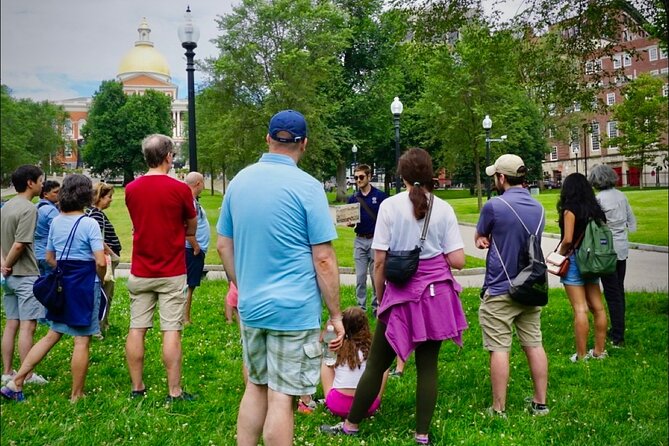
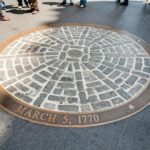
Then you hit the Boston Massacre Site, where British soldiers killed five Bostonians in 1770. This is one of the emotional pivots on the Freedom Trail, and your guide’s job is to help you understand why it mattered so quickly.
Right after, you reach Faneuil Hall Marketplace, known as the cradle of liberty and tied to town meetings (1742). In other words, you go from the moment violence gets reported and remembered, to the civic forum where communities argued about what to do next.
This pair of stops works well because it shows both sides of the Revolutionary pressure cooker: public opinion and public action. If you’ve ever wondered why protests needed both words and structure, you’ll see the logic fast here.
You can also read our reviews of more historical tours in Boston






North Square and the Paul Revere Stops: How Warnings Traveled
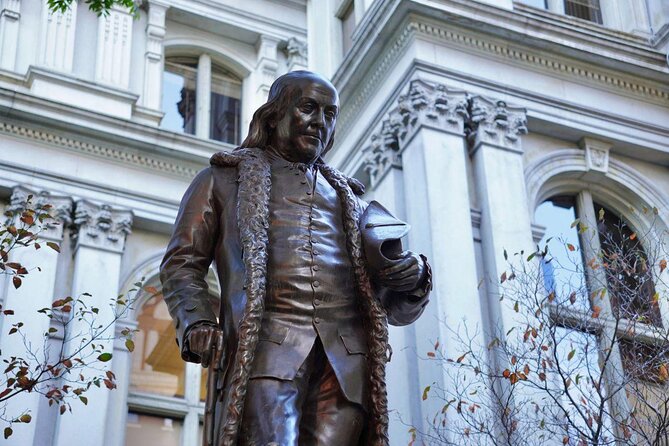
Next comes North Square Park, a historic public square in the heart of the North End (1634). It’s a quieter pause compared to the bigger headline sites, which is useful in a two-and-a-half-hour walk—your brain gets a moment to reset before the finale.
Then you move into the Paul Revere portion of the trail, including the Paul Revere House area and the pedestrian-only Paul Revere Statue stop honoring the Midnight Ride (1775). This is where the tour shifts from general tensions to a specific plan in motion.
You’ll also hear about Boston’s oldest church where signal lanterns were used during the Midnight Ride (1723). Guides often bring this moment to life with vivid explanation of how the signals helped people act under uncertainty, not knowing everything at once.
The burial-ground connections and the clustering of these points are a reminder that Revolutionary Boston wasn’t just kings and decrees. It was neighbors, meeting places, and communication that had to work in real time.
Copp’s Hill Terrace Views: USS Constitution and Bunker Hill Across the Water
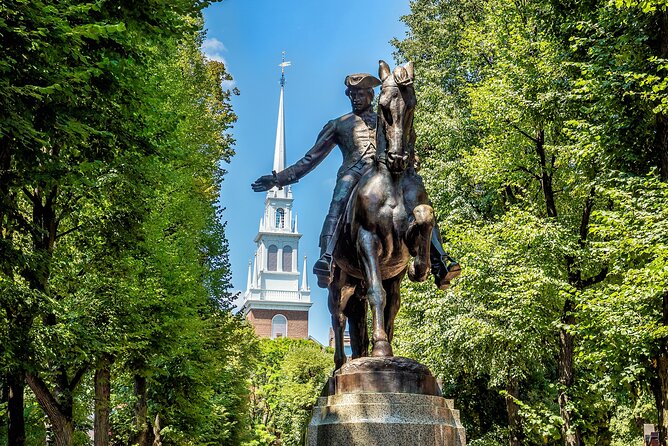
The walk ends at Copp’s Hill Terrace, with wide views toward the Charles River. From here, you’re looking toward the U.S.S. Constitution (1797) and the Bunker Hill Monument (1775 battle).
Even if you’ve seen these names on posters, seeing them from a single overlook gives you a more grounded sense of why this area mattered strategically. It’s a good way to close a tour focused on 1760–1775: you finish looking toward the next escalation.
Also, since the terrace is steps from Hanover Street, you can turn the last minutes into a practical plan. Eat first, then wander off to whatever sites you want to revisit more slowly.
Price and Value for $35.10: What You’re Paying For
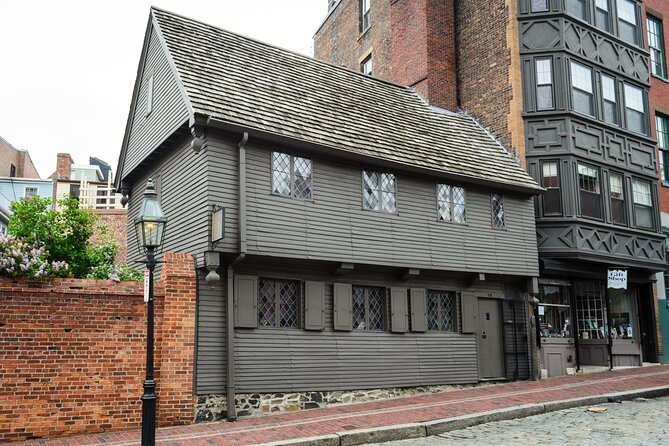
At $35.10 per person for roughly 2 hours 30 minutes, you’re paying for three big things: a historian guide, a small group experience, and a route that hits the core set of 16 official landmarks.
You’re not paying museum admission prices here. That’s good value if you’re okay focusing on outdoor sites, monuments, and story stops. It also means the cost is easier to justify if your time in Boston is limited and you want the Revolution thread without buying multiple tickets.
If you’re the type who wants to go inside every site, plan your budget accordingly. The tour specifically notes that admission inside museums is not included, and there can be limits on time for entering buildings during the walk.
A helpful workaround: discounted admission can apply for the Old South Meeting House and Old North Church using the Hub Town Tour ticket, and Kings Chapel may also have a similar discount soon. This is worth keeping in mind if those interiors matter to you.
Who This Tour Fits Best (and Who Might Want a Different Plan)
This tour is ideal if you’re:
- visiting Boston for the first time and want an organized way to understand the Revolution
- a history buff who likes explanation tied to exact locations
- traveling with a group of mixed interests, since the guide keeps the story moving and readable
It also works well for learning style: you’ll hear the Revolution years (1760–1775) while physically moving between the places where that story unfolded. That combo helps you remember more than you’d get from a map alone.
But it’s not for everyone. If you have difficulty standing for extended periods, this won’t be comfortable. The tour is described as wheelchair and stroller accessible, yet the general guidance is “moderate physical fitness” and not ideal for people who can’t stand long.
Should You Book This Freedom Trail Tour?
Book it if you want a strong first pass at Revolutionary Boston with a guide who can answer questions while you’re at the exact stop. At $35.10, you’re getting a focused storyline, small-group pacing, and all 16 official landmarks in one hit.
Skip or rethink it if you mainly want to spend time inside museums and churches. This experience is built around outdoor landmarks and timed stops, so you may need a separate visit later if interior access is your top priority.
FAQ
How long is the Boston Freedom Trail History walking tour?
The tour runs about 2 hours 30 minutes.
How much does the tour cost?
The price is $35.10 per person.
What does the tour include?
It includes the Freedom Trail with all 16 official landmarks, plus a small group format (maximum 16 guests) and downtown Boston and the North End.
Where do I meet the guide?
You meet at the Boston Foundation Monument at 49 Beacon St, Boston, MA 02108.
Where does the tour end?
The tour ends at Copp’s Hill Terrace, 520 Commercial St, Boston, MA 02109.
What languages is the tour offered in?
The tour is offered in English.
What topics does the historian guide focus on?
The guide focuses on the American Revolution years between 1760 and 1775.
Is the tour wheelchair and stroller accessible?
Yes. The tour is described as wheelchair and stroller accessible, but it recommends moderate physical fitness and notes it is not recommended for travelers who have difficulty standing for extended periods.
Are museums or indoor admissions included?
No. Admission inside museums is not included.
What happens if the weather is poor?
The experience requires good weather. If it’s canceled due to poor weather, you’ll be offered a different date or a full refund.
Can I cancel for a full refund?
Yes. You can cancel up to 24 hours in advance for a full refund, and refunds are not available if you cancel less than 24 hours before the start time.