REVIEW · HARVARD & MIT TOURS
Harvard University Campus Guided Walking Tour
Book on Viator →Operated by Trademark Tours · Bookable on Viator
Harvard on foot beats guessing. I like the student-led stories and the free illustrated Harvard Square map that help you orient fast in just over an hour. You’re not just looking at famous buildings—you’re picking up the small stuff that makes Harvard feel lived-in.
You start near the Harvard Square Red Line entrance, then your guide threads the walk with humor and real campus rhythm. In recent tour groups, I’ve heard names like Natalie (studying neuroscience) and Jonathan used as examples of how guides bring both school history and day-to-day perspective.
The main catch is that it’s mostly outdoors, and you’ll be seeing most buildings from the outside only. That matters on cold, windy days, and it also means this is not a classroom-and-library tour.
In This Review
- Key Highlights You’ll Actually Feel During the Walk
- Why Student-Led Harvard Tours Often Beat “Only Facts”
- Getting Your Bearings at Harvard Square and the Red Line Meet-Up
- Harvard Square First: Where the City Meets the Campus
- Harvard Yard in Motion: Seeing the Old University Feel
- John Harvard Statue: The Photo Stop That Teaches Campus Branding
- Harvard Art Museums Stop: Fogg, Busch-Reisinger, and Sackler
- Memorial Hall From the Outside: Beautiful, Iconic, and Short
- Science Center and Landmark Passing: The Quick Clues You Can Follow Later
- Ending at the Harvard Shop: Souvenirs Without Breaking the Flow
- Price and Timing: When $23 Feels Like a Smart Buy
- Weather Reality: What Cold Days Do to a Walking Tour
- Group Size and Pace: Great for Seeing, Not for Slow Study
- Who Should Book This Tour, and Who Should Choose Something Else
- Should You Book This Harvard University Campus Guided Walking Tour?
- FAQ
- How long is the Harvard University Campus Guided Walking Tour?
- What does the tour cost?
- Where do I meet the guide?
- Where does the tour end?
- What is the tour language?
- Does the tour run in rain?
- Are translations available for non-English speakers?
- Can we enter buildings during the tour?
- Is the tour accessible?
Key Highlights You’ll Actually Feel During the Walk

- Student guides with personal perspective: you’ll hear traditions and practical “how it works” comments from current students, like Natalie’s neuroscience angle or Evan’s personal essay stories.
- One tight route under a mile: you cover Harvard Square, Harvard Yard, major landmarks, and Memorial Hall without a long marathon.
- Harvard Square map included: you get an illustrated map you can use immediately for a self-guided follow-up.
- Stops that line up with Harvard’s art scene: the Harvard Art Museums section points you toward the Fogg, Busch-Reisinger, and Arthur M. Sackler Museums.
- Ends at a student-run souvenir shop: the tour finishes at the Harvard Shop, right where you can keep exploring.
- Language support in writing: written translations are available in Spanish, French, German, Italian, and Mandarin.
Why Student-Led Harvard Tours Often Beat “Only Facts”
A Harvard campus tour can turn into a slideshow fast. This one stays human. The point isn’t just that Harvard is old; it’s that students interpret the place every day, and your guide uses that lens as they point out what matters.
I especially like how student guides often mix three things in the same conversation: campus landmarks, the traditions behind them, and the small “how people really think about it” details. On some recent tours, guides like Natalie have shared trade-secret-style guidance for students (in her case, tied to neuroscience), and Evan has added a more personal angle by sharing what the Harvard essay process felt like for him.
That blend can help you, whether you’re a parent, a prospective student, or just a curious visitor. You leave with a sense of atmosphere, not just names stamped onto stone.
You can also read our reviews of more walking tours in Boston



Getting Your Bearings at Harvard Square and the Red Line Meet-Up
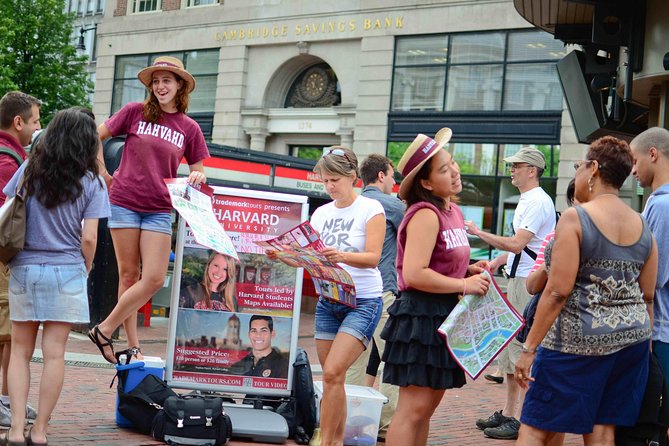
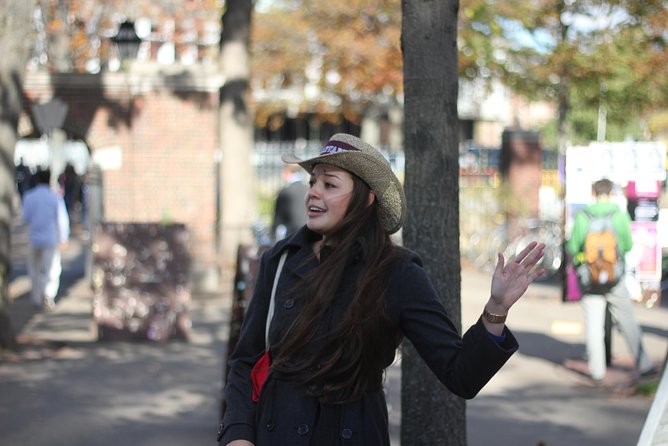
The tour meeting point is right where you’d want it if you’re using public transit: outside the Harvard Square Red Line subway station. Guides are easy to spot because they wear a straw hat, which saves you time when you’re scanning a busy sidewalk.
This matters because the first stop sets the tone. Harvard Square is one of those places where it’s easy to wander in circles if you don’t have a plan. Starting there means you can ask early questions and get context before you move into Harvard Yard.
You’ll also want to show up ready to walk. The route is under a mile total, but it still takes steady feet—especially if you arrive during rush periods or weather changes.
Harvard Square First: Where the City Meets the Campus

The tour begins in Harvard Square, and you’ll spend about 30 minutes here. This is smart pacing. Before you see iconic campus buildings, you get a feel for the surrounding energy that makes Harvard feel like a real neighborhood center—not a sealed-off campus bubble.
In practical terms, Harvard Square is where you can connect the dots. After the tour, you’ll likely want to return on your own, and that included illustrated map is designed for exactly that. Use it immediately while memories are fresh: circle a museum, a courtyard, or a landmark you want to see again.
If you’re traveling with family, this first stop is also a good “win.” It gives you something lively and recognizable quickly, even if the later campus sections are more formal and architectural.
Harvard Yard in Motion: Seeing the Old University Feel
Next you move to Harvard University, with about 25 minutes here. This is where you start reading the campus like a story. Harvard Yard is famous for its age and layout, but the real value is how your guide frames it—what the spaces were meant for, how traditions evolved, and why certain buildings loom so large in student life.
One reason this segment works for short trips: it gives you a coherent orientation. Instead of bouncing between random sites, you get a route that builds meaning step-by-step.
Here’s a key reality check, though: you should expect to view things from the outside. Even if you’re close to major buildings, the university does not allow tourists to enter academic buildings due to student safety. That’s not a deal-breaker for architecture lovers, but it does affect what kind of “inside look” you can reasonably expect.
John Harvard Statue: The Photo Stop That Teaches Campus Branding

The John Harvard Statue stop is about 15 minutes, and it’s one of the most photographed statues in the United States. That sounds like a simple photo moment, but it’s actually a useful checkpoint.
This is where you notice campus branding—how Harvard presents itself visually and symbolically. You’ll also get a chance to ask questions while the group is clustered at a landmark people already recognize from books, photos, and movies. It’s an easy moment to reset your attention before the art and memorial sections.
If you care about photos, come prepared with the mindset that this is a quick, focused stop. The tour keeps moving, and you’ll get your time, but you won’t get long, slow wandering.
You can also read our reviews of more guided tours in Boston






Harvard Art Museums Stop: Fogg, Busch-Reisinger, and Sackler
You’ll also pass through the orbit of the Harvard Art Museums. These are three museums—the Fogg, Busch-Reisinger, and Arthur M. Sackler Museums—all under one roof. The tour experience here is more about pointing you to what’s important than about spending a full museum session.
So plan this segment as orientation. If you want galleries and deeper looking, use the tour as your map and timing guide, then consider returning later for a proper museum visit. The upside is that even if you’re short on time, you’ll know what you’re choosing once you’re inside.
I like that this stop is included because art is part of the Harvard identity, not just science and academics. Even from the outside route, it helps your mental picture of Harvard feel more complete.
Memorial Hall From the Outside: Beautiful, Iconic, and Short
Memorial Hall is next, with about 15 minutes on the exterior. Your guide will point out what makes it iconic, but the key limit is that you won’t go inside as a group. You’re there for the architecture, the symbolism, and the way it fits into the campus story.
This is another good reason the tour works for families and first-timers: you get a strong payoff without adding the complexity of timed entries, lines, and uncertain access.
The trade-off is similar to the rest of the campus experience. If you’re hoping for classrooms, libraries, or a peek into how students attend lectures, this walking tour won’t deliver that. What it can deliver instead is a clear sense of what those academic spaces represent and where they sit within the wider campus map.
Science Center and Landmark Passing: The Quick Clues You Can Follow Later

Along the walk, you’ll pass additional major landmarks, including the Science Center area and Memorial Hall. These stops are most valuable when you think of them as clues.
When you return later on your own, you’ll know which corners are worth slowing down for. You’ll also be better at spotting the campus “logic,” meaning how older historic sections relate to newer academic spaces.
This is also where a good student guide helps you. They can point out what’s culturally important versus what’s just visually impressive. That’s often the difference between a good photo and a meaningful memory.
Ending at the Harvard Shop: Souvenirs Without Breaking the Flow
The tour concludes at the Harvard Shop, run by current Harvard students. It’s conveniently placed near major campus streets, and you might end at the Harvard Shop on Mt Auburn St or at the Harvard Shop on JFK St—both are right around the corner from each other.
I like ending here because it turns a timed walk into a chance to keep exploring at your own pace. If you want to pick up something small, this is the moment. If you don’t, it’s still useful as a waypoint to orient yourself for the next stop on your day.
Also, because it’s student-run, it can feel like an extension of the tour rather than a random retail stop dropped into your afternoon.
Price and Timing: When $23 Feels Like a Smart Buy
At $23 per person for about 70 minutes, the value is strongest if you match the right expectations. This isn’t a deep admissions counseling session. It’s a fast orientation plus insider storytelling led by students.
Given the route stays under a mile and you get a free illustrated map, you’re basically buying three things:
- a guided route through the historic core (Harvard Square and Harvard Yard),
- quick landmark context (statue, art museums area, Memorial Hall),
- and a student voice that makes Harvard feel understandable rather than distant.
If you’re traveling as a family, the short time window is a big plus. If you’re a prospective student, it helps you decide what you want to see next and how you want to experience it when it’s not a group schedule.
And if it’s cold where you are visiting from, remember: this tour can feel longer outdoors. Budget for layers, not just for time.
Weather Reality: What Cold Days Do to a Walking Tour
This experience operates year-round, including rain or shine. In extreme conditions, the organizers may pause or reschedule to keep it safe and comfortable.
In practice, this means you should dress like you’re going outside longer than you think—because you are. Recent tours have taken place in truly frigid conditions, and guides handled it by keeping the group moving and answering questions at stops. One guide named Lorenzo was praised for being considerate and helpful on a snowy day, which is exactly the kind of support you want when you’re bundled up and still cold.
Bring an umbrella for rain, and prioritize shoes with decent grip. Plan on stopping only where the route allows, not where you’d like to warm up.
Group Size and Pace: Great for Seeing, Not for Slow Study
The tour has a maximum of 40 travelers, and that group size affects the feel. The route is short, but the pace can be brisk because you’re covering multiple landmarks in under 90 minutes.
That’s perfect if you like structure and want to see the highlights without getting stuck in transit. It’s less ideal if you want long, stop-by-stop conversations or if you’re hoping to spend extra time inside specific places.
If you’re the type who asks a lot of follow-up questions, you can still do that—you’ll just want to save your biggest questions for the landmark moments where the group is naturally paused.
Who Should Book This Tour, and Who Should Choose Something Else
You should book if you want:
- a student perspective on Harvard traditions and campus culture,
- a quick walk through Harvard Square and Harvard Yard,
- a family-friendly introduction that doesn’t require a full day.
You might want to choose a different option if you’re looking for:
- deep admissions strategy and one-on-one style coaching,
- inside access to classrooms, libraries, or academic spaces.
This is more like a guided campus orientation with insider color, not a full admissions deep dive. That’s not a problem—it’s just the right mental frame.
Should You Book This Harvard University Campus Guided Walking Tour?
If your goal is a fast, story-driven introduction to Harvard’s Cambridge core, I think it’s a strong buy for the price. You’ll get a tight route, a free illustrated map, and a student-led narration that makes the campus feel real—especially if your visit is short or you want to understand the culture, not just the architecture.
Book it if you can handle mostly outdoor walking and you’re okay with viewing buildings from the outside. Skip it if your priority is entering academic buildings or getting detailed admissions answers.
FAQ
How long is the Harvard University Campus Guided Walking Tour?
The tour is approximately 1 hour 10 minutes.
What does the tour cost?
It costs $23.00 per person.
Where do I meet the guide?
You meet outside the Harvard Square Red Line subway station entrance. The guide wears a straw hat, and the start address is 1380 Massachusetts Ave, Cambridge, MA 02138.
Where does the tour end?
The tour ends at the Harvard Shop near Mt Auburn St or JFK St in Cambridge, MA (both are run by current Harvard students and are right around the corner from one another).
What is the tour language?
The tour is offered in English.
Does the tour run in rain?
Yes. It operates rain or shine year-round. In extreme weather conditions, the tour may pause or be rescheduled.
Are translations available for non-English speakers?
Written translations are available in Spanish, French, German, Italian, and Mandarin.
Can we enter buildings during the tour?
The university does not allow tourists to enter academic buildings due to student safety, so you should expect to view most areas from the outside.
Is the tour accessible?
The route is accessible at nearly every stop, but wheelchairs cannot be provided on site. If someone in your party has a disability, contact the provider before the tour.