REVIEW · FREEDOM TRAIL TOURS
Relive 1776: Interactive AR Experience on The Freedom Trail
Book on GetYourGuide →Operated by See Reality · Bookable on GetYourGuide
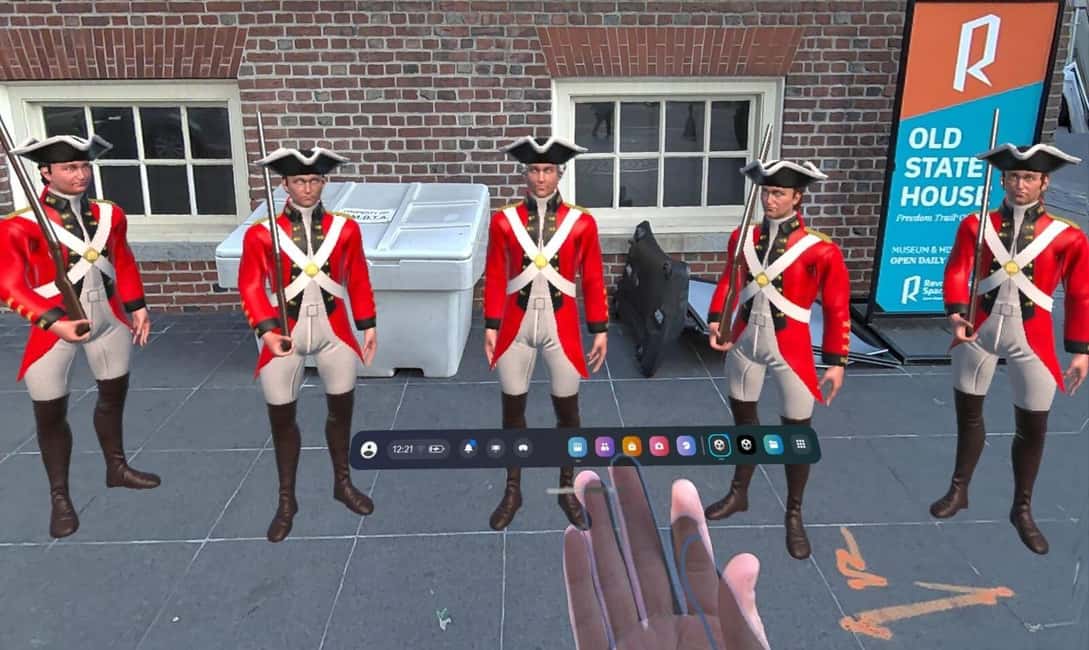
You won’t just look at the Freedom Trail. You’ll watch it play out in augmented reality right where it happened. What I like most is the way the story runs chronologically from 1765 to 1775, with characters appearing in the real Boston landscape.
Two standout wins: the interactive choices you make (including reactions from historically accurate English soldiers) and the mix of headset AR plus mobile phone AR, so you’re not stuck doing one thing the whole time. One thing to consider: the content includes soldiers and—depending on the version—guns, so if you scare easily or you’re sensitive to that, you’ll want the kids version.
In This Review
- Key things to know before you go
- Relive 1776 on the Freedom Trail: seeing Revolutionary Boston in the real world
- Price and time: does $30 buy enough value?
- Entering the timeline: from 1765’s tension to 1775’s showdown
- Stop-by-stop: Boston Common, Old State House, Paul Revere House, and Bunker Hill
- Stop 1: Boston Massacre Site (or an alternate start)
- Stop 2: Boston Common (about 15 minutes)
- Stop 3: Old State House (about 20 minutes)
- Stop 4: Paul Revere House (about 10 minutes) + transport to the final stop
- Stop 5: Bunker Hill Monument (about 20 minutes)
- AR headsets vs mobile phone AR: what gear you’ll actually use
- The guided component: how the “choices” stay understandable
- What to expect: no gore, and a kids version if you want less intensity
- Practical tips: how to get the most out of your Freedom Trail AR time
- Who should book Relive 1776 (and who should skip it)?
- Should you book Relive 1776?
- FAQ
- How long does the Relive 1776 tour take?
- Where does the tour start and end?
- Do you walk the whole route, including transportation to Bunker Hill?
- Do I use a headset or my phone?
- Is there gore in the AR simulation?
- Is there a kids version?
Key things to know before you go
- A 5-part AR story running from 1765 to 1775 across Freedom Trail sites
- Interactive characters (British soldiers and colonists) who react to your choices
- No gore, and AR instead of VR to avoid typical nausea/safety issues
- Small group size (up to 10 participants) with an English-only guide
- Short segments at each stop (about 5–15 minutes each) plus built-in pacing options
Relive 1776 on the Freedom Trail: seeing Revolutionary Boston in the real world
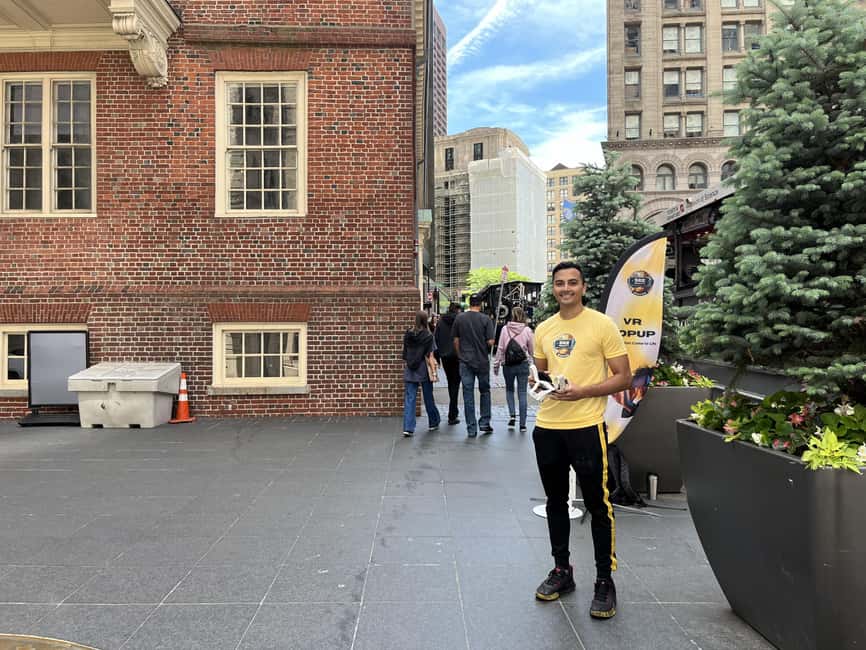
Relive 1776 turns the Freedom Trail from a list of plaques into a moving timeline. You start with history being “replayed” in front of you, then your guided walk strings together key moments as you progress toward Bunker Hill. It’s built around a very specific time window, 1765 through 1775, which helps you feel how events connect instead of hopping randomly from one era to another.
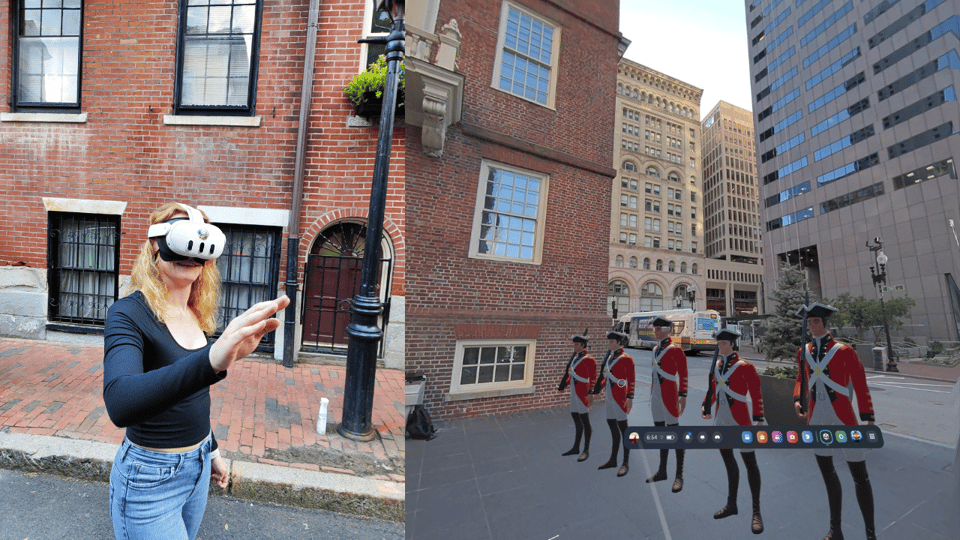
The best part is the AR layer. British soldiers and colonists appear in the real world near you, not in some separate screen-world. You don’t lose your sense of where you are on the street—AR keeps the real surroundings visible—so it feels like you’re witnessing the past right alongside today’s Boston.
You also get hands-on moments in the story world. The experience isn’t only “watch and listen.” It includes actions like helping stage events, trying on colonial fashion, and even operating a historically accurate field cannon at one point. And the experience is designed to be fun and educational, not a grim reenactment.
If you’re a history fan, you’ll like that the simulations are described as historically accurate (especially the soldiers and environment). If you’re not a hardcore history person, the storyline and interactive parts keep it from feeling like class.
You can also read our reviews of more tours and experiences in Boston.


Price and time: does $30 buy enough value?

At $30 per person, you’re paying for a guided, tech-driven experience—not a traditional lecture tour. Whether it’s good value depends on how you like to learn.
Here’s why it can feel worth it:
- You’re getting five AR scenes plus a live guide, rather than one quick stop.
- Each scene is short (about 5–15 minutes), so it stays energetic instead of dragging.
- You get transportation from the Paul Revere House to Bunker Hill included, which helps the day flow.
- The group stays small (limited to 10 participants), so you’re not lost in a crowd.
The total time ranges from 30 minutes to 2 hours, depending on starting times and how the pacing works for your group. That wide range is worth paying attention to when you’re scheduling. If your day is tight, choose a time slot that fits your plan, and remember you can go at your own pace or skip stops if needed.
One more value point: the tour is structured around the Freedom Trail, so you’re getting a “guided route” plus a storyline you can actually remember—not just photo stops.
Entering the timeline: from 1765’s tension to 1775’s showdown
Relive 1776 is built as a chronological, 5-part experience. You’ll meet key historical figures as the story moves forward, and the AR scenes are staged to feel like they’re happening again at each location.
A major early anchor is Boston Common, where you meet Paul Revere, John Hancock, and Samuel Adams under the Great Elm Tree. This matters because it sets the tone: you’re not only learning facts, you’re acting as part of the people preparing to resist.
The storyline is described as wide-ranging, and the events aren’t all the same flavor. In addition to the cannon moment and the fashion try-on, you’ll see British soldiers and colonists appear and then react to the choices you make. That kind of interactivity is the core reason this isn’t just another “walk and hear commentary” tour.
And it builds to the final stop at Bunker Hill, where the AR tour ends. If you like a clean arc—setup, rising tension, climax—this format tends to land well.
Stop-by-stop: Boston Common, Old State House, Paul Revere House, and Bunker Hill

The experience is organized around multiple Freedom Trail sites. You also have options for where you start and where you end based on booking.
Stop 1: Boston Massacre Site (or an alternate start)
Your tour kicks off at one of two start options. One option is the Boston Massacre Site area; another listed starting location is the Commodore John Barry Memorial (depending on what you book). This first part sets the stage for the conflict you’ll be stepping into.
What to look for here: the first AR beats are often the most surprising, because it’s where you confirm the tech actually places characters in the real street view. It also helps psychologically—once you’ve seen the soldiers appear once, the rest of the storyline becomes easier to follow.
A practical note: since this is the first stop, I’d plan to arrive a touch early and get comfortable with the guide’s instructions before you put on any headset.




Stop 2: Boston Common (about 15 minutes)
Boston Common is where the story finds its political and personal center. You’ll have a guided segment and sightseeing around about 15 minutes, then you meet Paul Revere, John Hancock, and Samuel Adams under the Great Elm Tree as part of the AR scenes.
Why this stop works: it gives you faces and context fast. The Freedom Trail can feel like you’re reading dates off a map; meeting these figures in place makes the timeline feel more human and less textbook.
What to expect in practice: a guide-led flow, then AR character moments while you’re standing in the real location.
Stop 3: Old State House (about 20 minutes)
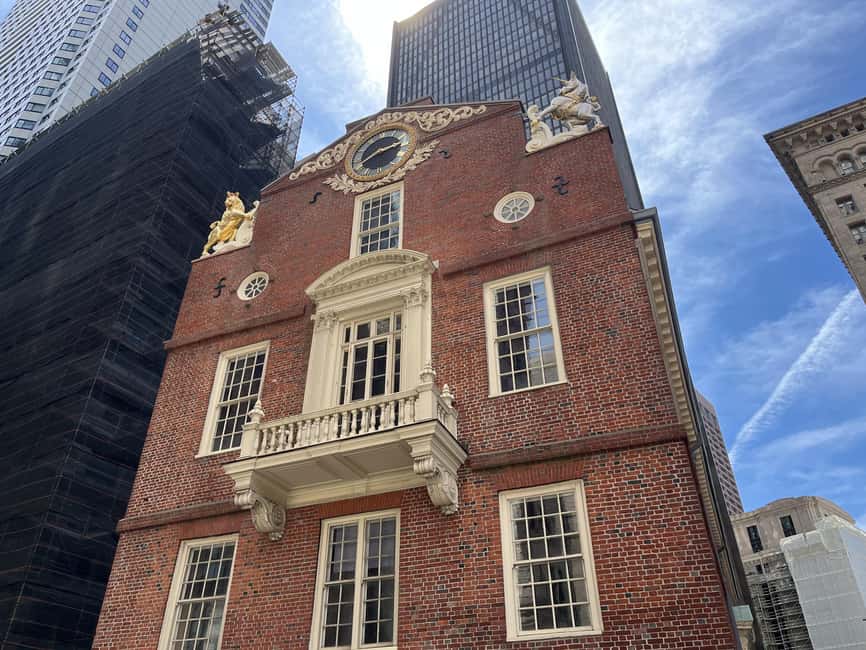
Next up is the Old State House, with a guided segment and sightseeing around 20 minutes. This is another key Revolutionary-era site, and the AR story continues as British and colonist characters appear and interact with what’s happening in your view.
This stop’s value is continuity. By now, you’ve started recognizing how the storyline connects to the landmarks around you. If you like making mental links—cause, consequence, action—this is where the tour starts to click.
Stop 4: Paul Revere House (about 10 minutes) + transport to the final stop
The Paul Revere House is a shorter segment (about 10 minutes). But you’re not left on your own after this. Transportation is included from the Paul Revere House to Bunker Hill.
That included transport is a smart design choice. It means you don’t have to worry as much about route planning in the middle of a tech-heavy activity. You can stay focused on the story instead of timing street crossings and walking distances.
Stop 5: Bunker Hill Monument (about 20 minutes)
The tour’s final AR chapter ends around Bunker Hill Monument, with a guided segment and sightseeing around 20 minutes.
Why the ending matters: Bunker Hill is the kind of location where you want the full emotional payoff. The AR format helps because you’re not just looking at a monument—you’re stepping into the conflict moments tied to that site.
The day ends back at the meeting point area, with drop-off options listed as Boston Massacre Site or Bunker Hill Monument depending on how you booked.
AR headsets vs mobile phone AR: what gear you’ll actually use
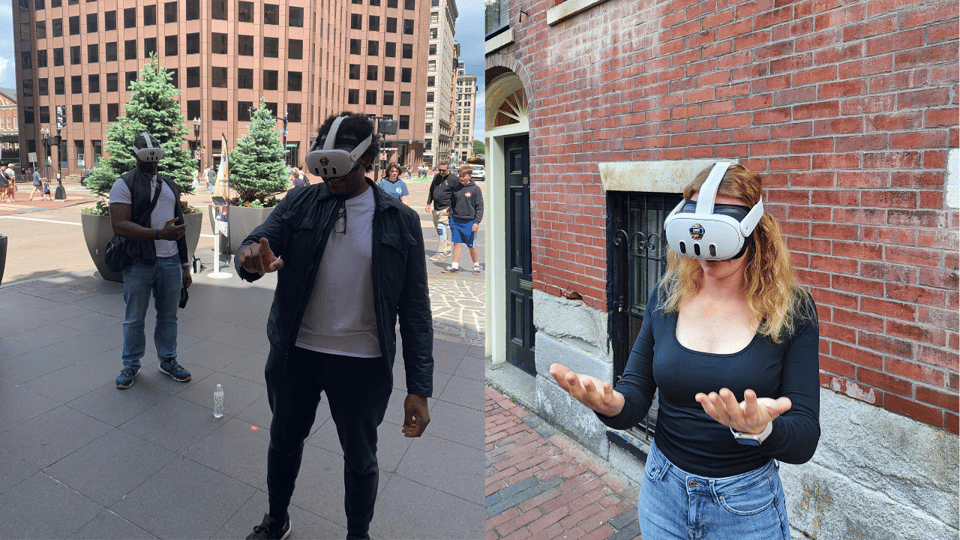
One reason people love this tour is that it doesn’t lock you into one device. The experience uses both:
- Mobile phone AR for three of the experiences
- AR headsets for two of the experiences (and they provide the headsets)
If you’re worried about motion sickness: this is AR, not VR, so you won’t be cut off from reality, and the experience is described as avoiding nausea/safety issues.
Also, headset handling is addressed directly. It’s stated that headsets are sanitized for each participant, with a claim of killing 99.99% of bacteria and viruses, and you can get a fresh facial cover for each participant (optional). Headsets are shared, but the sanitation step is part of the design.
Who will feel most comfortable with this? People who don’t want the “sit in a VR bubble” feeling, and people who prefer learning that still includes the surrounding streets.
One more detail to keep in mind: the tour is rated as not suitable for people with epilepsy and not suitable for people with heart problems. If either applies, skip this activity.
The guided component: how the “choices” stay understandable
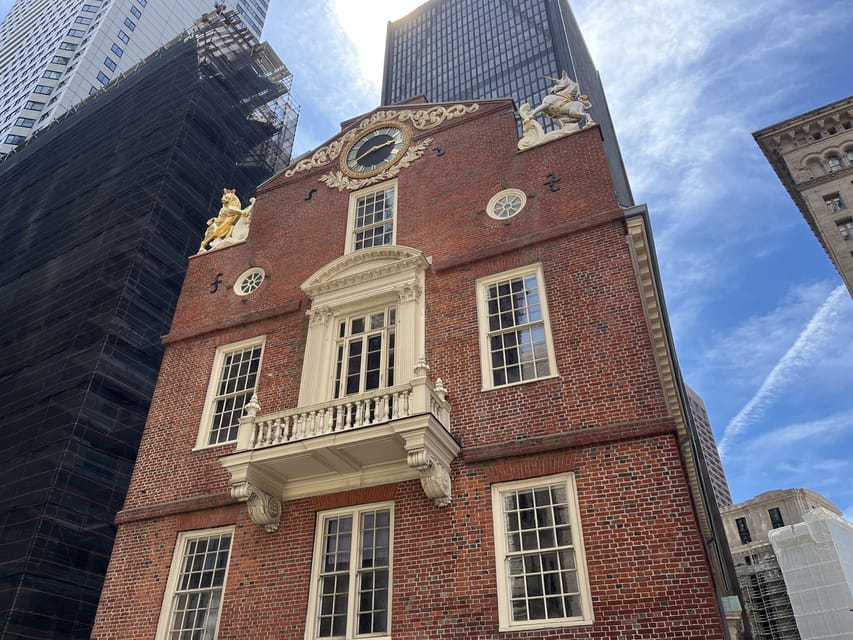
Tech alone doesn’t make this a good tour. The guide does. You’re paired with an English-only guide, and each segment includes guide-led direction.
The storyline is interactive: British soldiers and colonists appear and then react to what you do. That’s fun, but it can also be confusing if you’re not given context. The guide is there to explain how it works and what you’re meant to do.
One guide is specifically praised for technical know-how: Dylan is called out for exceptional technical knowledge and for explaining how everything worked. Even if you don’t get the same guide, the presence of a guide throughout is the safety net that turns “cool tech” into “I learned something.”
What to expect: no gore, and a kids version if you want less intensity
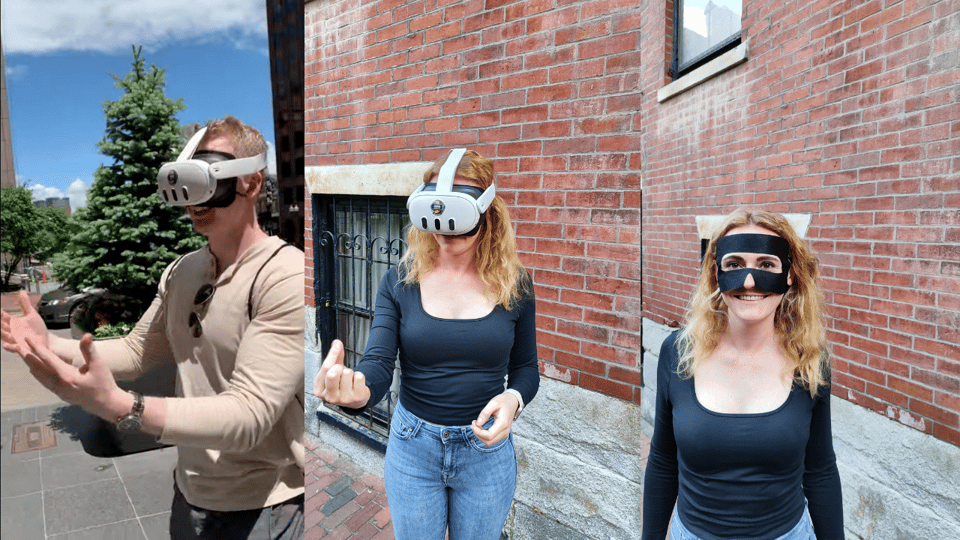
The tour includes guns in the simulation depending on the version. The experience explicitly says there is no gore (so no graphic violence), and it also notes a kids version is available without guns.
This is a key planning point. If you’re going with younger kids, or if you know you get startled easily, choose the kids version. The experience is still designed to be fun and educational; the goal is to keep the tone age-appropriate.
If you’re an adult and you like historical realism, the “historically accurate soldiers” and the way characters interact with you is one of the most praised elements of the whole experience.
Practical tips: how to get the most out of your Freedom Trail AR time
Here are the small choices that help the experience run smoothly.
1) Dress for walking and waiting.
Even though the AR scenes are short, you’re still on the Freedom Trail. Wear comfortable shoes and plan for weather. You’ll be standing around for each segment while characters appear in your view.
2) Arrive ready to follow instructions.
Because you’ll use both a headset and (at times) your phone AR, you’ll do better if you start relaxed. Give yourself a few minutes before your assigned start to get oriented.
3) Use the freedom to skip if you need speed.
The tour says you can go at your own pace and even skip stops if you’re in a hurry. This helps if you’re juggling a tight itinerary with other Boston must-dos.
4) Think about the length range when you book.
Total duration ranges from 30 minutes to 2 hours. If you have dinner reservations or a museum time slot, pick a start time that matches your schedule—and don’t assume it will always land at the shortest end.
5) Know the basic rules.
Littering isn’t allowed, which is standard, but it’s good to remember in public outdoor sites.
Who should book Relive 1776 (and who should skip it)?
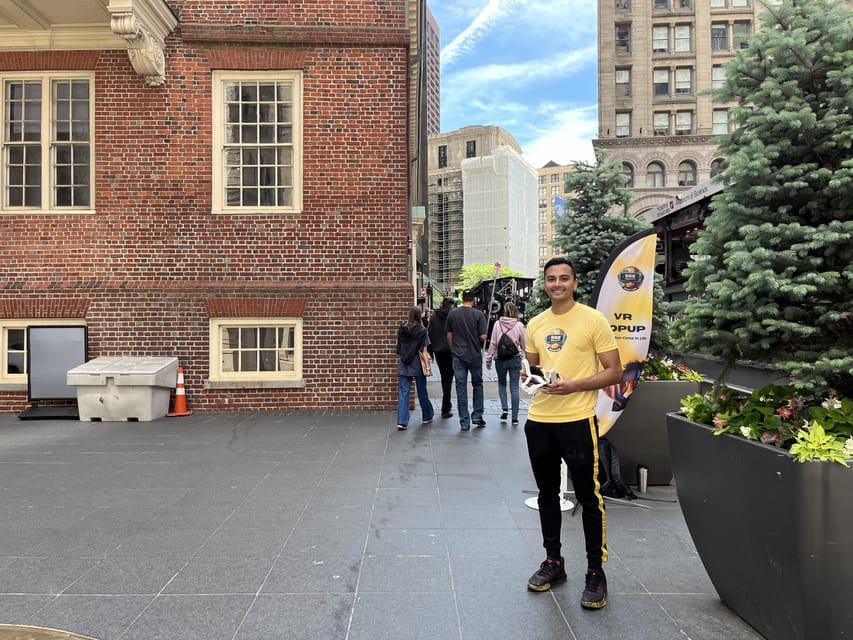
This tour is a great fit if you:
- Want an alternative to museum-only history
- Like hands-on, interactive learning
- Enjoy the Freedom Trail but want more than narration and photos
- Enjoy tech that keeps the real world visible (AR, not VR)
It’s especially appealing for first-time visitors who want one activity that ties multiple landmarks into a single story arc.
You may want to skip or choose another option if you:
- Have epilepsy or heart problems (explicitly listed as not suitable)
- Are going to be really uncomfortable with gun-related simulation (pick the kids version if that’s you)
Should you book Relive 1776?
Yes—if you want Boston history that feels like it’s happening in front of you, this is one of the few options that turns famous sites into an actual story trail. The combination of a guided five-part timeline, interactive character moments, and AR placed in the real streets is what makes it memorable. At $30, you’re paying for the technology and the guidance, and the short segment pacing helps it feel focused rather than long.
Book it with confidence if you’re curious about how AR can make the Revolutionary War era easier to picture. Consider the kids version if you want to reduce the intensity, and read the medical suitability note carefully if you have any concerns.
If your priority is quiet contemplation, you might prefer classic self-guided Freedom Trail walking. But if your priority is a “wait, that soldier is in the real world” moment paired with a real timeline—this is a smart use of time in Boston.
FAQ
How long does the Relive 1776 tour take?
The total duration is listed as 30 minutes to 2 hours, depending on starting times. Each of the five experiences lasts about 5–15 minutes.
Where does the tour start and end?
Start and end points can vary depending on what option you book. Drop-off locations are listed as Boston Massacre Site or Bunker Hill Monument, and the tour ends back at the meeting point.
Do you walk the whole route, including transportation to Bunker Hill?
You’ll have the walk-and-stop experience on the Freedom Trail sites, and transportation from the Paul Revere House to Bunker Hill is included.
Do I use a headset or my phone?
The tour uses both: three experiences use mobile phone AR, and two use AR headsets that they provide.
Is there gore in the AR simulation?
No. The simulation includes no gore.
Is there a kids version?
Yes. A kids version is available and it is described as being without guns.