REVIEW · FREEDOM TRAIL TOURS
Boston: Freedom Trail History Small Group Walking Tour
Book on GetYourGuide →Operated by Hub Town Tours · Bookable on GetYourGuide
Freedom Trail facts hit different on foot. This small-group walking tour takes you through Downtown Boston and the North End with a local guide telling the stories behind the American Revolution.
I love the way this route connects landmarks into one continuous story, not a grab bag of stops. I also like the pacing: with a group capped at 16, you can actually hear the guide and ask questions without fighting for sidewalk space. The one watch-out is simple—this is an outdoor, walking-focused tour (about 2 miles), so come with comfortable shoes and expect some uphill city walking.
In This Review
- Key things that make this tour worth your time
- Freedom Trail on a small-group scale: why it feels different
- Starting at Boston Common and the Boston Foundation Monument
- Boston Common to Massachusetts State House: government, religion, and friction
- Park Street Church and King’s Chapel: Boston’s competing voices
- Granary Burying Ground: the people behind the slogans
- Boston Latin School, Franklin, and Old City Hall: the city as a classroom
- Old Corner Book Store: why printed words mattered
- Old South Meeting House and Old State House: protest in public
- Boston Massacre Site: a short stop with a big emotional charge
- Faneuil Hall and the Quincy Market break
- Paul Revere House and Hanover Street: the run-up to action
- Paul Revere Statue, Old North Church, and Copps Hill: the North End finale
- Price and value: what $39 buys you for 2.5 hours
- Who should book this Freedom Trail tour (and who might not)
- Should you book it?
- FAQ
- How long is the Boston Freedom Trail walking tour?
- Where do you meet, and where does the tour end?
- What does the tour include?
- Is admission to museums included?
- Is the tour wheelchair accessible?
- What should I wear or bring?
- What’s allowed on the tour?
Key things that make this tour worth your time
- Small groups (up to 16) keep it conversational instead of a herd.
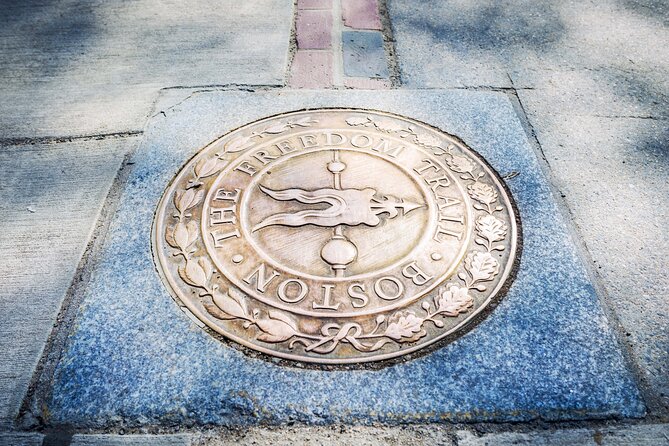
- All 16 official Freedom Trail landmarks get you a full, coherent walk.
- Revolution-era stories explain loyalty vs. rebellion in plain language.
- Downtown + North End payoff ends near Old North Church and great Italian food.
- Strong guide energy: guides such as Cyrus, Josh, Cal, Nick, Matt, and Lin have been praised for keeping the group engaged and answering questions.
Freedom Trail on a small-group scale: why it feels different
The Freedom Trail can be crowded, loud, and a bit chaotic when you try to do it on your own. On this tour, you get a tighter group size (16 guests max), so you don’t spend half your time dodging strollers or craning your neck.
This is also a story-first walk. You’re not just reading plaques—you’re getting the context for why people in Colonial Boston made the choices they did, even when it meant risking everything. That’s what turns a line on the ground into a real sense of time and pressure.
Finally, the price is low enough that you can treat it as a foundation stop on your trip. For $39, you get a guided route that covers the heart of the trail plus the North End finale—without paying museum admission along the way.
You can also read our reviews of more walking tours in Boston

Starting at Boston Common and the Boston Foundation Monument
You meet inside Boston Common at the Boston Foundation Monument, on the northern boundary of the park near the Boston Foundation bronze relief of two men shaking hands (a nod to the Puritans arriving in 1630). It’s a smart start point because it sets the tone: this isn’t just about 1776—it’s about the decades that led there.
From the start, the guide frames the big idea: a turbulent 15-year period where everyday people had to decide where loyalty really belonged. That theme matters as you walk, because many stops on the Freedom Trail aren’t only about battles—they’re about arguments, protests, and public pressure.
You’ll also get an initial orientation of where the trail leads, so later viewpoints make more sense. When you know what you’re walking toward, those famous names start sticking.
Boston Common to Massachusetts State House: government, religion, and friction
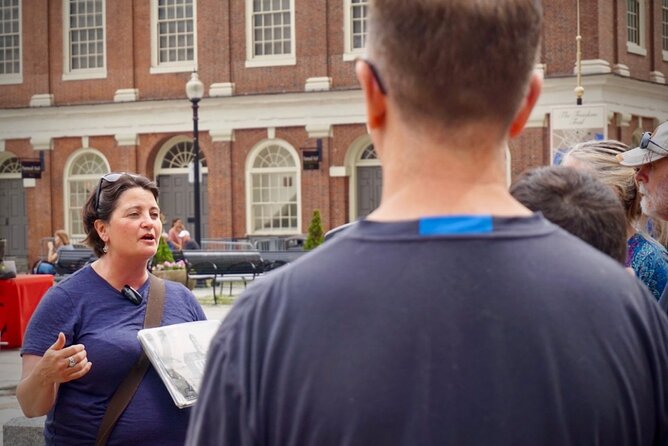
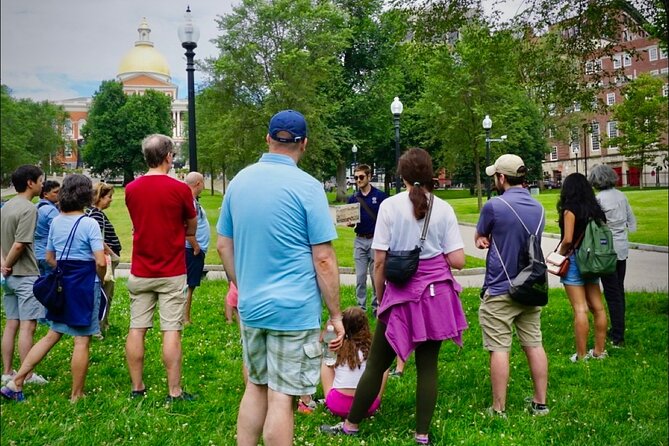
The first major landmarks pull you into the political and civic core of Boston. You’ll spend time at the Massachusetts State House and nearby church spaces, and the guide uses them to explain how power and belief shaped public life.
Even if you’ve seen photos of the State House area, it lands differently when you connect it to the Revolutionary backstory: who held authority, who challenged it, and why ordinary people cared. The guide’s job here is to make that complicated web feel understandable.
This part of the tour tends to move at a steady pace—enough time to hear the story, not so much time that you feel stuck. If you like walking tours where you cover ground, you’ll probably enjoy the rhythm.
Park Street Church and King’s Chapel: Boston’s competing voices
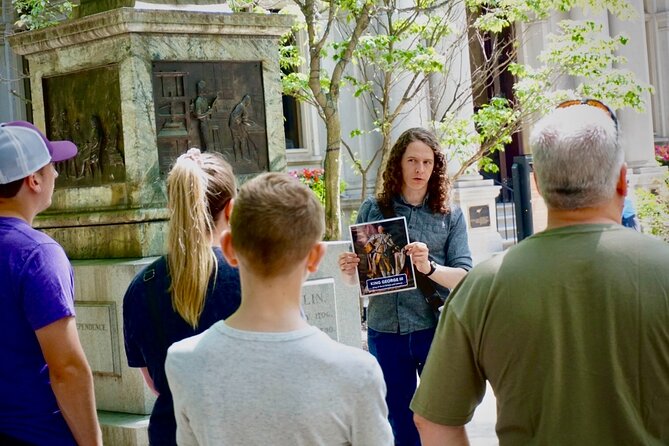
A couple of stops later, you pass Park Street Church and then King’s Chapel. These aren’t just pretty historic buildings. They’re used as context for how community leaders influenced public opinion.
You’ll hear how Revolutionary Boston didn’t come out of nowhere. It grew from long-running tensions—religion, governance, and who got to speak for the public. That’s where a guided explanation really helps; the buildings make sense, but the why takes a human voice to connect it all.
One practical note: you’re outdoors and moving between stops, so dress for wind and changing light. Boston weather loves to do quick plot twists.
Granary Burying Ground: the people behind the slogans
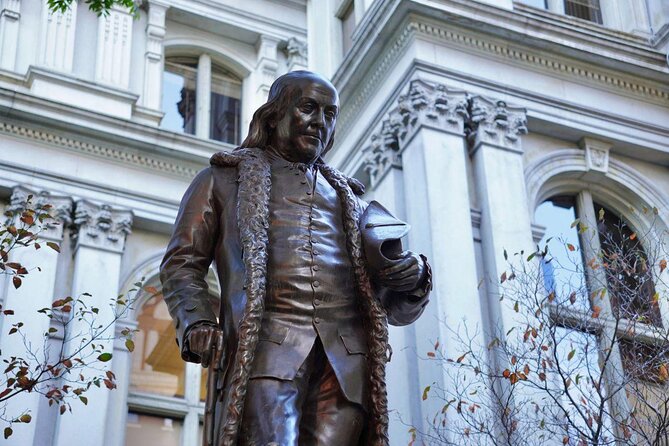
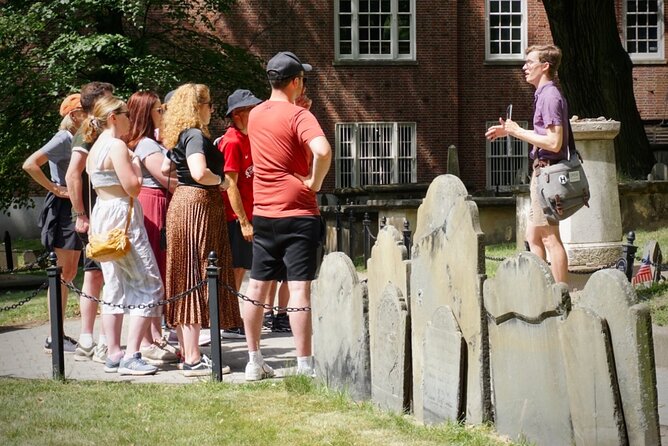
At Granary Burying Ground, the tour slows down for a guided look (about 25 minutes). This is one of those stops where the Revolution stops being an abstract timeline and becomes personal.
Cemeteries do that. You’re surrounded by the reality that these were real communities with real families, not just nameplates on a worksheet. The guide typically uses this setting to talk about key figures like Paul Revere, Samuel Adams, and other Revolutionary era names tied to Boston’s civic story.
If you’re the type who likes to connect history to real people, this is a highlight. It also works well for photography—just remember you’re sharing the space with others, so keep moving when the group does.
You can also read our reviews of more historical tours in Boston






Boston Latin School, Franklin, and Old City Hall: the city as a classroom
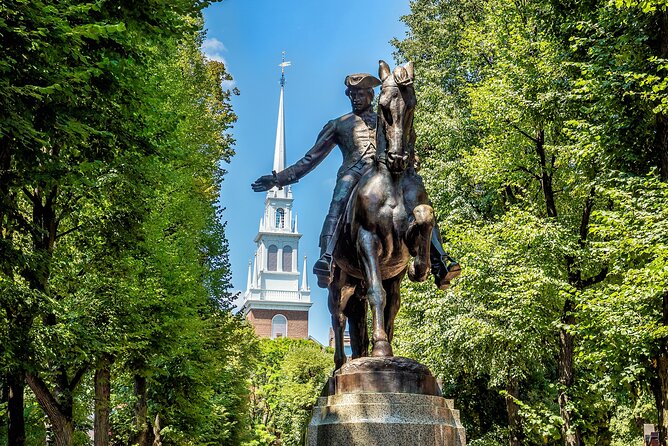
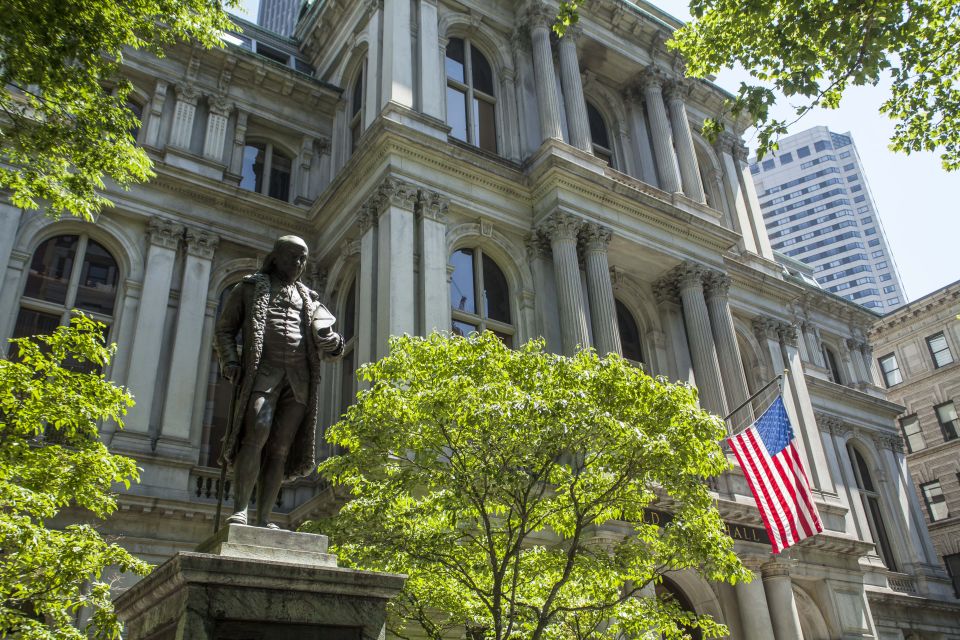
Next up you’ll hit Boston Latin School and the Benjamin Franklin statue, followed by Old City Hall. These stops shift the story from protest and conflict to education, ideas, and civic identity.
Benjamin Franklin is more than a statue name for this tour. The guide uses him as a thread to explain how Enlightenment thinking and practical leadership shaped Revolutionary debate. You start noticing that Boston didn’t just argue about independence—it argued about how society should work.
Old City Hall adds another layer by showing how institutions evolved. Again, you’re not just looking at brick and stone; you’re watching the city’s logic unfold in real time as the guide connects past roles to future outcomes.
Old Corner Book Store: why printed words mattered
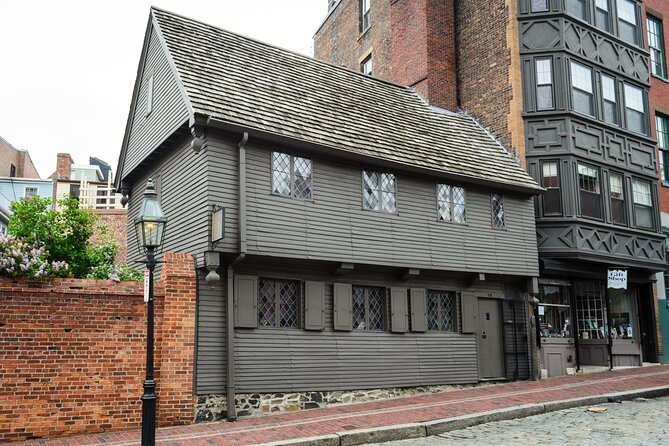
At the Old Corner Book Store, the guide focuses on the role of print culture and public messaging. This is a key stop because it helps you understand that Revolution-era conflict wasn’t only about muskets and marches.
Talk of loyalty and rebellion lived in pamphlets, newspapers, and speeches. When someone’s ideas could travel, they could spread quickly—so controlling information became its own kind of power struggle.
It’s a quick stop, but it tends to leave you thinking about modern parallels. You don’t need to overdo comparisons; just notice how public opinion can move faster than government can react.
Old South Meeting House and Old State House: protest in public
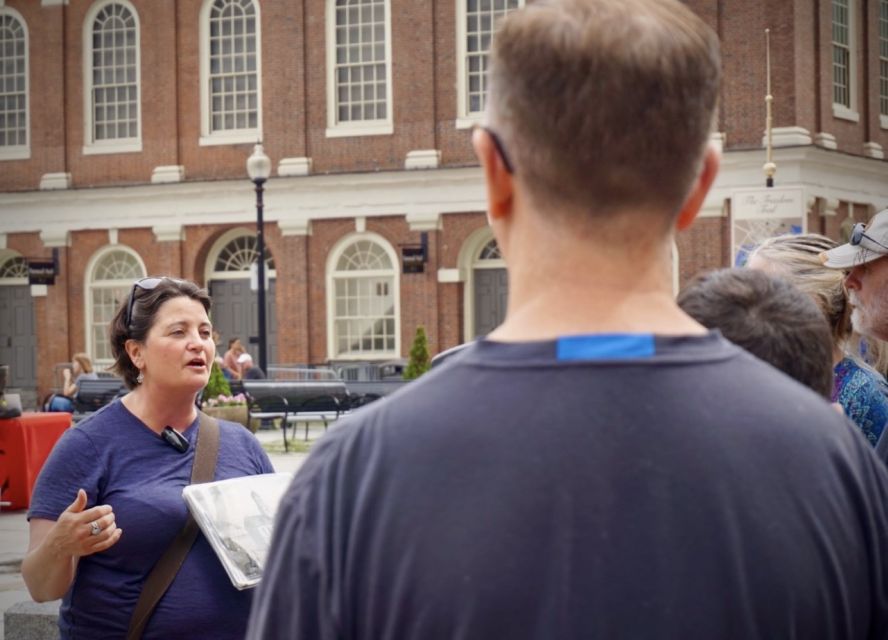
Two of the biggest story anchors come next: Old South Meeting House and the Old State House. Both stops are designed to show you where public pressure became organized pressure.
Old South is where Revolutionary Boston gets noisy, visible, and collective. Old State House helps you understand the consequences of that public tension—how officials responded and how citizens pushed back.
The guide’s explanation is the difference here. Stand around long enough and you can read plaques. But a good guide helps you see why people showed up, what they wanted, and what they feared if they were wrong.
If you’re sensitive to heavy political talk, you’ll still be okay. The stories are grounded in what people did and said, not in abstract lectures.
Boston Massacre Site: a short stop with a big emotional charge
At the Boston Massacre Site, you’ll get a guided moment (about 15 minutes). This is one of those locations where the guide’s framing matters, because the event is widely known but often misunderstood in everyday retellings.
You’ll hear how this wasn’t just an explosion of violence. It was a public turning point that amplified anger and helped fuel further resistance. The setting adds weight, and the guide’s pacing keeps it from dragging.
I like that this tour doesn’t rush through the emotional parts. It gives you time to process why the event stuck in people’s minds.
Faneuil Hall and the Quincy Market break
Next comes Faneuil Hall, followed by a short break at Quincy Market (about 10 minutes). Faneuil Hall has a reputation as a meeting place for debate, and the guide ties that directly to the Revolutionary “argument in the streets” theme.
Then you get a breather. Quincy Market is right there, so this is a handy moment to grab a drink or a snack and reset your legs. Don’t over-plan your timing here—you’re still working on a schedule, and you’ll want to rejoin the group smoothly.
This short pause also makes the rest of the North End climb feel manageable.
Paul Revere House and Hanover Street: the run-up to action
The tour shifts from civic debate to the people who made the plan real. You’ll visit the Paul Revere House and then move through Hanover Street.
These stops tend to land well because they focus on the human side of the Revolution. Revere isn’t just a name; you learn how his role fit into a larger system of messages, timing, and risk.
At Hanover Street, you get that “you are here” feeling. You’re walking through the part of Boston where the North End story tightens, and the guide helps you connect the Revolution’s big events back to everyday neighborhoods.
If you enjoy tours where the guide makes the streets feel alive, this segment is a strong payoff.
Paul Revere Statue, Old North Church, and Copps Hill: the North End finale
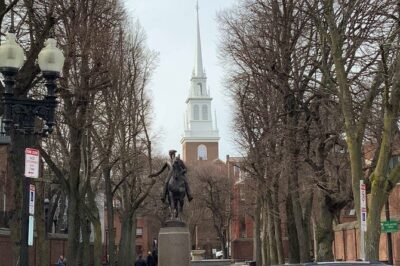
At Paul Revere Statue and then Old North Church, the tour builds toward the most famous North End imagery. Old North Church is where the story often turns into legend, but the guide keeps it rooted in what was possible and what was risky at the time.
Then comes Copps Hill Burying Ground and the North End viewpoint at Copps Hill Terrace. This finale is great because it’s both historical and practical: you’re steps from Old North Church and close to the North End’s Italian food scene.
Even better, on the way you’ll get scenic views toward the U.S.S. Constitution and the Bunker Hill Monument over in Charlestown. That view helps you understand how the Revolution spread across Boston’s geography, not just its downtown grid.
Copps Hill Terrace is also a nice last stop because it gives you a visual wrap-up. You can look around and finally see the trail as a map of connected places.
Price and value: what $39 buys you for 2.5 hours
At $39 per person, you’re paying for guided interpretation of the entire Freedom Trail experience, not just a few highlight stops. You also get the small-group cap, which matters more than people expect. If you’ve ever tried to learn while being jostled every few feet, you’ll understand why that’s a real value driver.
The tour covers around 2 miles and lasts about 2.5 hours, with a cap of 3 hours. That’s a comfortable length for most visitors because it fits into a morning or afternoon without eating your whole day. Also, admission inside museums isn’t included, but the tour focuses on what you can learn directly at the landmarks.
If you’re visiting Boston for the first time, this is a smart use of time. It gives you structure fast—where to go next and what to notice when you walk there on your own.
Who should book this Freedom Trail tour (and who might not)
This walk is a strong match if you want:
- A guided path that covers the full set of Freedom Trail landmarks
- Stories that explain the politics and the pressure, not just facts
- A group size small enough for real interaction
It’s also ideal if you like guides who bring energy. The best-rated experiences mention guides like Cyrus, Josh, Cal, Nick, Matt, Miles, Will, and Lin, with praise for humor, pacing, and turning history into something you can follow.
One consideration: it’s not a quick stroll. You’re outside, walking between stops, and it’s marked as not suitable for people with low fitness or mobility impairments. If you know you’ll struggle with sustained walking, you may want a more flexible option.
Also, plan for practical rules: no luggage or large bags, and no video recording. Light daypack only.
Should you book it?
Yes, if you want the Freedom Trail in a way that actually teaches you something. This tour is built for people who care about context—why people chose rebellion, how loyalty got complicated, and how Boston’s public places shaped the course of American independence.
I’d especially recommend booking if you’re short on time or you hate feeling lost in a crowd. The small-group format keeps it human, and the route ending near Copps Hill Terrace makes it easy to roll right into dinner in the North End after.
If you’re planning a super relaxed trip, this may feel a bit brisk. But if you’re willing to put on good shoes and walk with your eyes open, it’s one of the most cost-effective ways to understand Revolutionary Boston without wasting hours.
FAQ
How long is the Boston Freedom Trail walking tour?
The tour lasts about 2.5 hours, and it won’t be more than 3.0 hours.
Where do you meet, and where does the tour end?
You meet inside Boston Common at the Boston Foundation Monument (near 50 Beacon Street). The tour finishes at Copps Hill Terrace.
What does the tour include?
It includes the Freedom Trail covering all 16 official landmarks, plus a guided walk through Downtown Boston and the North End in a small group (16 guests max).
Is admission to museums included?
No. Admission inside museums is not included.
Is the tour wheelchair accessible?
The activity is listed as wheelchair accessible, and the accessible route travels approximately 2.0 miles (3.2 km). The activity is also marked not suitable for people with mobility impairments, so you’ll want to judge your own comfort with the walking route.
What should I wear or bring?
Bring comfortable shoes and weather-appropriate clothing.
What’s allowed on the tour?
No luggage or large bags are allowed, and video recording is not allowed.