REVIEW · FREEDOM TRAIL TOURS
Downtown Freedom Trail Walking Tour – History & Architecture
Book on Viator →Operated by Boston CityWalks · Bookable on Viator
Boston’s biggest stories fit in a sidewalk stroll. On this Freedom Trail walking tour, you connect famous Revolutionary-era sites with the buildings around them, from Faneuil Hall toward Boston Common. I love the small-group pace—it feels like you can actually hear and ask questions—and I like how the guide points out what to look up at, not just where to stand.
You’ll get stops that make the timeline click: the Boston Massacre site marked in the pavement, King’s Chapel, and the Old Corner Bookstore where famous writers once met. I also like that you’re not stuck at one theme; you get architecture plus street-level history. One thing to plan for: parts of the route can be noisy or breezy, and at times it can be hard to hear without a microphone, so staying close to your guide helps.
In This Review
- Key highlights to clock before you go
- Freedom Trail in one hour: what this tour does best
- Your route: from Faneuil Hall and the Old State House to Boston Common
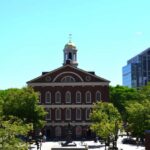
- Faneuil Hall and Quincy Market: protests, the Revolution, and something to look up
- The Boston Massacre site and Park Street Church: where street markings hold meaning
- King’s Chapel and the Old Corner Bookstore: when religion, governance, and ideas share the same streets
- Old State House and the battle for authority: the balcony moment that matters
- Old South Meeting House, Tea Party signals, and Boston Irish Famine Memorial: beyond dates
- Old City Hall, Boston Latin School site, and Tremont Temple: civic power and social change
- Old Granary Cemetery, Paul Revere, and the final sweep to Boston Common
- Price and value: is $45 worth it?
- Guide style, sound, and small-group comfort (what to watch for)
- Weather and what to wear for this Downtown walking loop
- Extending your day: the option to go past Boston Common
- Who this tour is best for
- Should you book the Downtown Freedom Trail Walking Tour?
- FAQ
- How long is the Downtown Freedom Trail Walking Tour?
- Where does the tour start and where does it end?
- How much does the tour cost?
- What’s included in the tour?
- What is the meeting time?
- Is the tour offered in English?
- Is it suitable for families or kids?
- How big are the groups?
- Does the tour run in bad weather?
- Do I get a ticket on my phone?
- What’s the cancellation window for a full refund?
Key highlights to clock before you go
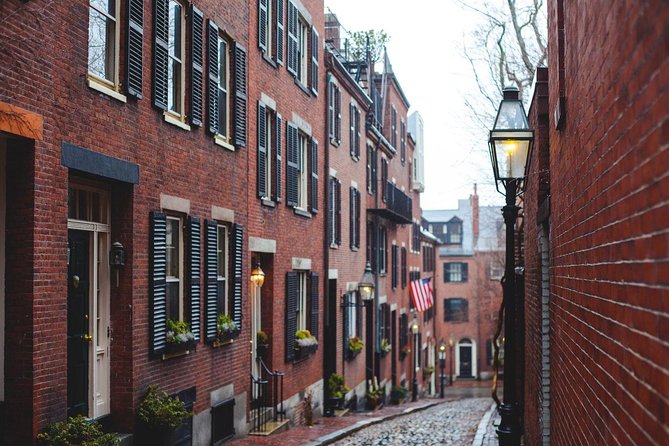
- Small group size (max 20) means less crowding and more room for questions
- 70 minutes gives you a focused Downtown Freedom Trail loop without eating your whole day
- Architecture + history on the same stops, from colonial meetinghouses to government buildings
- Iconic callouts like the cobblestone ring for the Boston Massacre and the grasshopper weathervane
- Real Boston context, including the Boston Irish Famine Memorial and Tremont Temple’s story
- Ends at Boston Common and the State House view, a smooth finish for first-timers
Freedom Trail in one hour: what this tour does best
If you’ve ever tried to do the Freedom Trail on your own, you know the problem. You can walk the red line, but the city doesn’t hand you the meaning. This tour is built to fix that. In about 70 minutes, you get the plot, the power shifts, and the why-behind-the-where—without needing to cram museum hours into your schedule.
The route is concentrated in Downtown Boston, so it’s a great fit when you’re jet-lagged, short on time, or traveling with kids who need frequent visual payoffs. It also works well as a first stop on your trip, because you leave with a mental map you can reuse the rest of the day.
You can also read our reviews of more walking tours in Boston

Your route: from Faneuil Hall and the Old State House to Boston Common
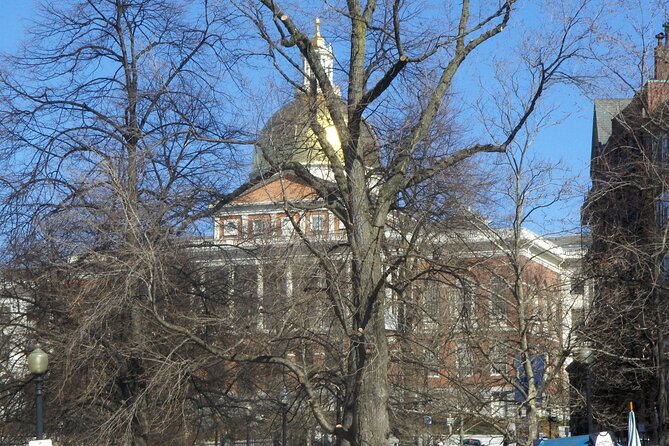
The walk runs along the spine of the Freedom Trail, with the guiding flow from Faneuil Hall’s revolutionary spark toward the seat of modern government overlooking Boston Common. The tour starts at State Street at Congress Street and ends at the Brewer Fountain on the Freedom Trail, so you don’t have to backtrack.
Along the way, you’ll pass a mix of:
- marketplaces and meeting spaces tied to protests and public debate,
- churches and civic buildings that show how power was expressed in architecture,
- and a cemetery and park that anchor the story in real names and real urban space.
A nice bonus is that the tour doesn’t treat history like a distant textbook. It keeps tying old events to how Boston talks about those events now—so the walking feels purposeful, not just scenic.
Faneuil Hall and Quincy Market: protests, the Revolution, and something to look up
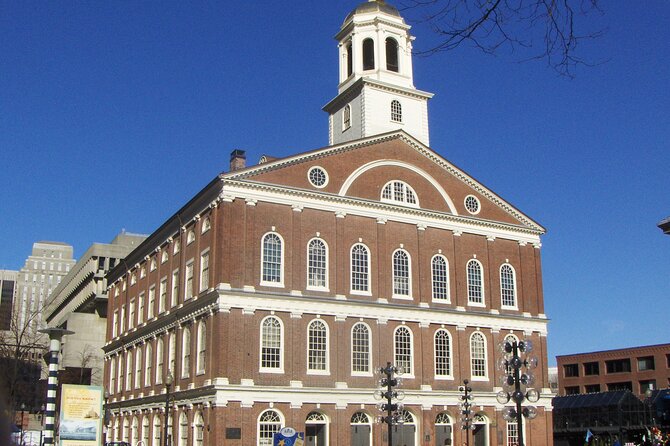
Faneuil Hall is one of those places where the building itself feels like it’s still talking. On this tour, you learn why it’s often called the Cradle of Liberty, and you see the connection between public space and public action.
Right in the same early segment, you’ll also make your way past Quincy Market. It’s a lively area, but the guide’s job is to keep it from becoming just a food-stop. The goal is to help you see how markets weren’t only about commerce—they were where people gathered, argued, and organized.
One small detail that matters more than you’d think: the tour includes a reminder to look up at the grasshopper weathervane. It’s the kind of cue that turns a quick glance into a moment you remember later.
The Boston Massacre site and Park Street Church: where street markings hold meaning
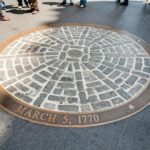
The tour stops at the Boston Massacre site, marked by a cobblestone ring in the pavement. That single visual marker is powerful. It’s also useful for first-timers, because it teaches you how Boston embeds major events right into the street layout—so you can find the story even after your guide moves on.
Not far from that, Park Street Church adds another layer: the way churches and steeples shaped the Downtown skyline and helped people orient themselves in an older city layout. Even if you’re not a hardcore architecture fan, it helps you understand why certain buildings still dominate sightlines.
Tip for your own comfort: wear shoes you can stand in. You’ll be stopping more often than you might expect, and Downtown Boston streets aren’t exactly flat and friction-free underfoot.
King’s Chapel and the Old Corner Bookstore: when religion, governance, and ideas share the same streets
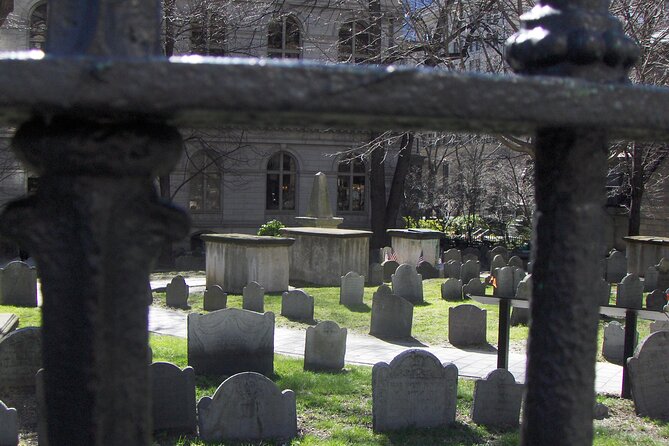
King’s Chapel is one of the most time-spanning stops on the route. The church’s story runs from its founding in 1686 through the Revolution and into modern Boston. The payoff here is the sense of continuity—how one site can survive political upheaval and still shape the neighborhood.
Then the tour brings you to the Old Corner Bookstore at 283 Washington Street near School Street. It’s a compact but memorable stop because the building’s uses changed over time:
- built as a residence and apothecary shop (1718),
- became a bookstore (1828).
This is where you get a fun mental image: big-name writers such as Ralph Waldo Emerson and Charles Dickens (among others) once gathered here. Even if you’re not chasing author trivia, it helps you see Boston as a city of conversation and publishing, not only politics.
You can also read our reviews of more historical tours in Boston






Old State House and the battle for authority: the balcony moment that matters
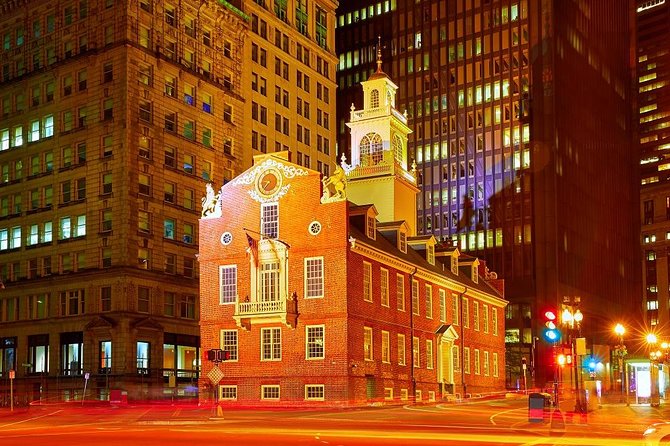
As you move along the Downtown stretch, you’ll pass the Old State House and learn why it mattered. It was the seat of British colonial government, and the Declaration of Independence was first read to Bostonians from its balcony.
That’s the kind of fact you don’t forget once you’re standing in the right place. It also makes the walking tour feel more like a story you can touch. Buildings become evidence.
The guide also brings in the surrounding architecture so the point isn’t only that a reading happened—it’s where public authority was displayed and how the city communicated power through prominent structures.
Old South Meeting House, Tea Party signals, and Boston Irish Famine Memorial: beyond dates
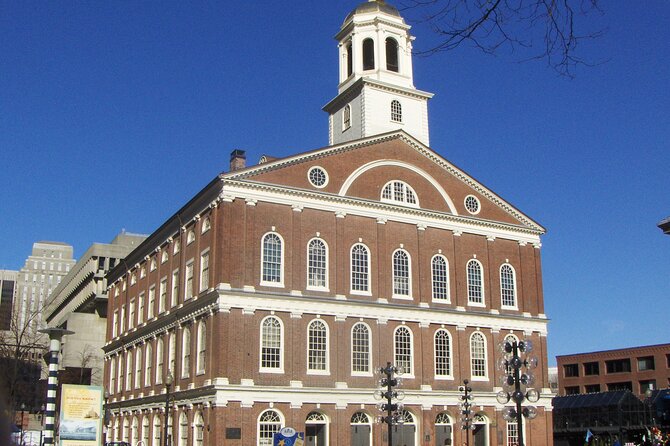
A major highlight is the stop at the Old South Meeting House, the massive brick church where signals were given to start the Boston Tea Party in 1773. This is one of the tour’s best examples of why the architecture matters. The meetinghouse isn’t just a backdrop—it’s part of how public action was organized.
Later, you’ll reach the Boston Irish Famine Memorial, a small memorial park on a plaza between Washington Street and School Street. The layout helps the story land: statues contrast an Irish family suffering during the Great Famine (1845–1852) with a prosperous family that had immigrated to America.
That stop does two things well:
1) It broadens the Freedom Trail conversation beyond the Revolution.
2) It reminds you Boston is still writing history into public space long after the 1700s.
Old City Hall, Boston Latin School site, and Tremont Temple: civic power and social change
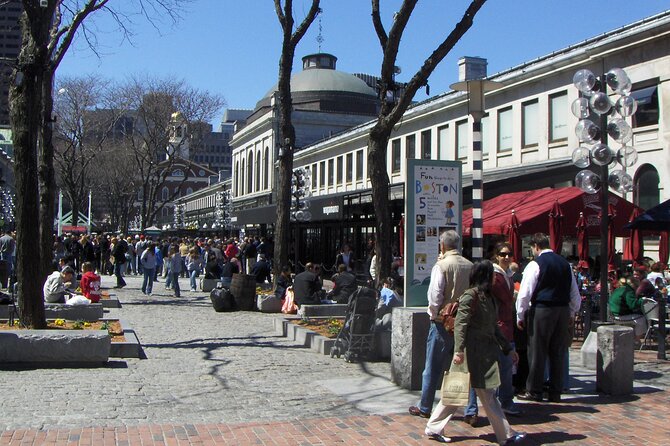
On the civic side, Old City Hall is worth your attention. It housed the Boston City Council from 1865 to 1969, and it was designed in the French Second Empire style—one of the earlier uses of that style in the United States. Even if you just take it in as a visual, the building helps explain how a city’s government grows up over time.
The route also includes the Boston Latin School site. The school was founded on April 23, 1635, known as the first public school in America, originally on School Street. A statue of Benjamin Franklin and a sidewalk mosaic mark the original location. This is one of the quieter stops, but it’s meaningful because it shows education as part of civic identity.
Then comes Tremont Temple, tied to the story of Timothy Gilbert and an unusually open church model for its time. The tour’s account highlights it as the first integrated church in America, and notes that it offered open attendance without charge. You also hear about public events hosted there, including an Egyptian mummy display in 1850, plus influential anti-slavery speeches.
If you care about social history, this is a strong segment. If you expected only Revolution politics, this is where you get a wider Boston: not just how independence happened, but how communities changed afterward.
Old Granary Cemetery, Paul Revere, and the final sweep to Boston Common
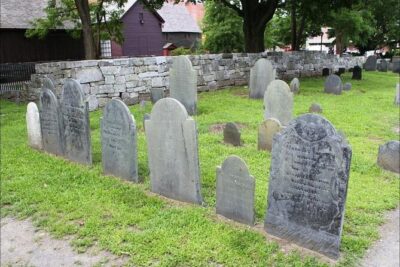
The walk includes a stop at Old Granary Cemetery, a final resting place for major names like Paul Revere, Samuel Adams, and John Hancock. This is a fast stop, but it’s high impact. You’re not looking at “history in general.” You’re looking at specific lives tied to specific moments.
Then the route ends where it should: at Boston Common, the oldest city park in the United States, made up of about 50 acres bounded by major streets like Tremont, Park, Beacon, Charles, and Boylston.
The finish also includes the view toward the New State House with its 23-karat gold dome, built in 1798 and still the seat of government. It’s a satisfying visual close: you start with colonial-era public gathering spaces and end with the civic center that replaced them.
Price and value: is $45 worth it?
At $45 per person, the tour isn’t the cheapest way to walk the Freedom Trail—but it’s also not trying to be. The value comes from three places:
- Time savings: you get a curated loop that prevents you from wandering in circles trying to connect facts.
- Interpretation: the guide ties architecture, street layout, and public events together so the landmarks feel like one story.
- Group dynamics: the tour caps at 20 travelers, which keeps the experience from turning into a loud conga line.
Also, the tour lists passes for major landmarks such as Faneuil Hall, King’s Chapel, and Boston Common. Even when many of the spaces are viewable on your own, having someone point out what’s worth your minute is what you’re paying for.
Guide style, sound, and small-group comfort (what to watch for)
The overall vibe from guide performance is positive: guides tend to be friendly, engaging, and willing to work with families. You may run into guides named Alan or Andrew in different groups, and both are associated with humor and clear explanations that keep a history lesson from feeling like a lecture.
One practical consideration: even with a small group, Downtown Boston streets can be windy and crowded. If you’re sensitive to audio, sit or stand near the front of the group and keep your ears open during street crossings and busier sections.
If you’re traveling with kids, the tour’s format is generally interactive enough to hold attention. Just know that questions and quick participation can happen.
Weather and what to wear for this Downtown walking loop
This is an all-weather tour. That’s great in the sense that you’re not constantly hunting alternate plans, but it means you should prepare like you mean it.
Bring layers. Bring a rain shell if the forecast looks questionable. And if you’re visiting in a day with events in Boston Common, expect crowds at the finish area—those are outside the tour’s control, but they can affect your final minutes.
Extending your day: the option to go past Boston Common
The standard route finishes at Boston Common, but there’s an option some people consider: a longer follow-on tour that continues onward. One common choice is to add time toward the areas beyond the Common, depending on what you want to see next. If you might extend, ask early so your plan stays simple.
Who this tour is best for
This works especially well for:
- First-time Boston visitors who want the story fast and in the right order
- History lovers who like context tied to buildings
- Families, since the pacing and variety keep kids from getting bored
- People who want a structured walking plan rather than trying to figure out the Freedom Trail logic alone
If you’re the type who wants a deeper, book-like treatment of each decade (or you prefer quiet, solo exploration), you might pair this with self-guided wandering after. The tour is a strong overview, not a replacement for hours in archives or museums.
Should you book the Downtown Freedom Trail Walking Tour?
Yes, if you want a focused, highly walkable introduction to Downtown Boston’s Revolution-to-government story, and you like your history explained in plain language at street level. The small-group size and the mix of architecture and key sites make it a smart use of time, especially on a first trip.
I’d skip or reconsider if you:
- hate guided formats and want full DIY freedom,
- need very quiet, low-crowd conditions for learning (Boston sidewalks can be loud),
- or expect a totally museum-style, ultra-detailed history lecture at every stop.
FAQ
How long is the Downtown Freedom Trail Walking Tour?
It runs for about 1 hour 10 minutes (the tour is described as a 70-minute walking experience).
Where does the tour start and where does it end?
It starts at State Street at Congress Street, Boston, MA 02203, and ends at the Brewer Fountain on the Freedom Trail in Boston, MA 02108.
How much does the tour cost?
The price is $45.00 per person.
What’s included in the tour?
You get a professional guide, a 70-minute walking tour focused on Boston’s Freedom Trail, and passes for landmarks and sites such as Faneuil Hall, King’s Chapel, and Boston Common.
What is the meeting time?
The start time is listed as 10:00 am.
Is the tour offered in English?
Yes, the tour is offered in English.
Is it suitable for families or kids?
It’s described as suitable for families. Children must be accompanied by an adult.
How big are the groups?
The experience has a maximum of 20 travelers.
Does the tour run in bad weather?
It operates in all weather conditions. You’ll want to dress appropriately. If it’s canceled due to poor weather, you’ll be offered a different date or a full refund.
Do I get a ticket on my phone?
Yes. The tour uses a mobile ticket.
What’s the cancellation window for a full refund?
You can cancel up to 24 hours in advance for a full refund. If you cancel less than 24 hours before the start time, the amount paid won’t be refunded.