REVIEW · FREEDOM TRAIL TOURS
Boston’s Freedom Trail: A Self-Guided Tour of All 16 Sites
Book on Viator →Operated by VoiceMap Audio Tours · Bookable on Viator
Boston’s history is loud and walkable.
This self-guided Freedom Trail tour uses the VoiceMap app, so you get 16 stops with offline audio and maps you can trigger as you walk. What makes it fun is the tone: guided-feeling storytelling, but at your pace.
I love two things most. First, the navigation and pacing are very usable—audio can start automatically when you reach the next location, and the map keeps you oriented without you studying your phone nonstop. Second, the narration connects the dots between places and people, from Samuel Adams at Faneuil Hall to the Boston Massacre details near State Street, and it does it with humor, not a sleepy lecture.
One thing to consider: this is an audio app experience, so it depends on your phone battery and signal-free use. If the map positioning is a bit off, you may need to tap forward or replay a segment when you reach the next stop.
In This Review
- Key Things I’d Put on Your Radar
- Why This Self-Guided Freedom Trail Works So Well
- Value Check: $14.99, Lifetime Access, and Offline Audio
- Quick budget reality
- Your Walk in Order: From Tremont Street to Copp’s Hill Terrace
- How the self-guided timing feels
- What to do before you start
- Faneuil Hall and the Tea Party Planning Heart of Boston
- The practical takeaway
- State House, Old City Hall, and Laws Carved Into Public Space
- Why this section matters
- The Graveyard Stops and the 1713 Trading-Era Building
- If you like “people history”
- A small pacing tip
- Paul Revere, the Irish Immigrant Story, and Boston Massacre Details
- How to listen here
- Old City-to-Market Break Strategy: Beantown Pub and the Outdoor Market
- Practical advice
- A Couple of Logistical Notes That Affect Your Experience
- The good: directions and pacing
- The not-so-perfect: GPS and manual taps
- The finish point versus “extra sights”
- Should You Book This Freedom Trail Audio Tour?
- FAQ
- How long does the Freedom Trail self-guided tour take?
- What does the $14.99 price include?
- Do I need to bring headphones?
- Where does the tour start and where does it end?
- Is it available in English?
- Do I need phone service to use it?
- Are museum tickets included?
- Is this tour private?
Key Things I’d Put on Your Radar
- Offline access to audio, maps, and geodata means you can keep walking without worrying about cell service
- Auto-start audio can make the trail feel effortless instead of “press play forever”
- Lifetime access lets you repeat the walk later, or review sections you want to revisit
- Clear, easy directions help you avoid the usual Freedom Trail confusion at intersections
- A few narration quirks can happen with GPS accuracy, so be ready to manually move ahead
- A practical finish near Copp’s Hill Terrace, with the route focused on trail interpretation rather than museum ticket time
Why This Self-Guided Freedom Trail Works So Well
The Freedom Trail can feel like two different trips at once. You’re walking through real streets and buildings. But you’re also hearing a long, fast-moving story.
This tour solves that second part with story-first audio. Each stop is framed like a scene: what happened, who was involved, and why the place matters. You’re not just reading plaques—you’re getting context in a voice that keeps things moving.
It also helps that you can set your own pace. One of the best parts of this format is the ability to slow down when something catches your attention—then keep going without worrying about losing a group. That freedom matters on the Freedom Trail because some spots are quick, while others reward extra time.
You can also read our reviews of more guided tours in Boston



Value Check: $14.99, Lifetime Access, and Offline Audio

At $14.99 per person, you’re not paying for a live guide’s time. You’re paying for a high-quality audio route plus the tools to run it. The big value here is that you get lifetime access to the tour in English, so it’s not a one-and-done ticket.
You also get offline access to audio, maps, and geodata. That’s a practical win in Boston, where you can easily drift into spots with dead phone coverage—especially near older buildings and busier corners. Offline mode means you can still follow the trail, even if your bars aren’t great.
One more point: the tour includes the VoiceMap app for Android and iOS, but it does not include a smartphone or headphones. If you want good sound (and you should), bring your own earbuds.
Quick budget reality
- The price covers the audio tour only.
- Food and drink are on you.
- Museum or attraction tickets aren’t included (so you’ll decide what’s worth stopping for).
Your Walk in Order: From Tremont Street to Copp’s Hill Terrace
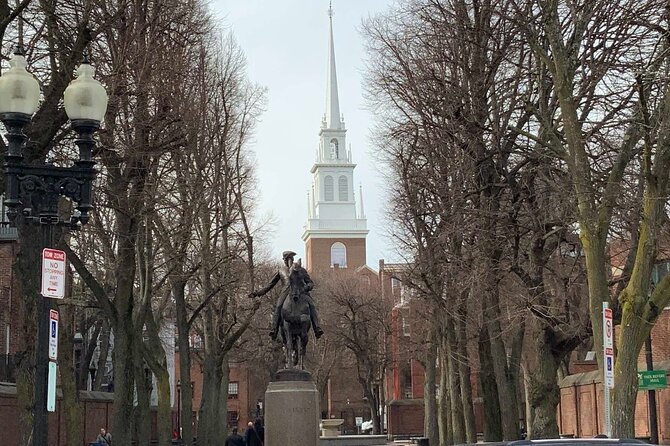
Your start is 139 Tremont St, Boston, MA 02111, and the tour ends at Copp’s Hill Terrace, 520 Commercial St, Boston, MA 02109. The listed hours are effectively 12:00 AM to 11:59 PM daily, so timing is really about your energy, not a tour schedule.
Expect about 2 hours to 2 hours 40 minutes to do everything included. In practice, I’d plan for around 2.5 hours if you listen fully and pause at key markers.
How the self-guided timing feels
With the app, you’re basically following a chapter-by-chapter walk. One of the standout benefits in the experience is that the map and timing elements help you keep up with the story at a natural walking rhythm. When it’s working smoothly, it feels like you’re being guided—just without the pressure.
You can also read our reviews of more tours and experiences in Boston






What to do before you start
Download ahead and make sure the tour is ready before you hit the first stop. Keep an eye on battery life. Audio + maps can drain your phone faster than you’d expect.
Faneuil Hall and the Tea Party Planning Heart of Boston
You begin with Faneuil Hall, a place Samuel Adams used to speak and a building that still functions as a kind of government hall. Even if you don’t go inside a museum, this is a stop that sets the tone. Boston’s revolution didn’t start as abstract ideas. It started with meetings, speeches, arguments, and public pressure.
From there, the tour broadens into the big Revolutionary themes you’ll keep hearing along the trail:
- colonists meeting and deciding how to resist
- the chain reaction from protest to revolution
- and the way street-level moments turned into national turning points
The tour calls out the Boston Tea Party planning connection at Old South Meeting House, described as the largest building in colonial Boston at one point. This is where you get a stronger sense of scale. It wasn’t a few people having a bad day. It was an organized event, planned through community action.
You’ll also hear about the tea itself—specifically the story of 92 tons of tea tossed into Boston Harbor—framed like a “so that’s what a party looks like” moment, which makes the history stick.
The practical takeaway
At these early stops, listen for two things:
- how public meetings worked as a political engine
- how protest actions were coordinated, not random
That’s the part people often miss when they only think of the later battles.
State House, Old City Hall, and Laws Carved Into Public Space
Next up: Brewer Fountain and then the Massachusetts State House, described as an impressive gold-and-brick structure. This section helps you shift from street-level drama to government-level power—how Boston’s leaders and institutions grew teeth.
Then you move to the Old City Hall façade and the tour’s focus on the birth of the American legal system. You’re not just looking at a pretty building front. You’re standing in the kind of space where ideas about law became something enforceable.
Why this section matters
The Freedom Trail can get reduced to “fights and speeches.” But this part of the walk keeps reminding you of the behind-the-scenes work:
- creating legal frameworks
- building civic institutions
- translating ideology into rules
If you want the story beyond slogans, this is where it starts to feel real.
The Graveyard Stops and the 1713 Trading-Era Building

One of the more memorable sections is the walk through a beautiful graveyard tied to Boston’s founding figures. The names highlighted here are big ones: James Otis, John Hancock, Paul Revere, and Samuel Adams. Seeing these names together does something plaques alone don’t: it makes the Revolution feel like a network of people, not a single hero timeline.
Right after that, you’ll reach one of Boston’s oldest buildings dating back to 1713, with a focus on Boston’s unique trading position. The point isn’t just age. It’s that Boston’s location and commerce helped shape what kind of resistance it could organize—and how fast ideas could spread.
If you like “people history”
This is the section for you. You get the sensation that the trail is following individuals through the city, not just bouncing between monuments.
A small pacing tip
If you want to get full value, don’t rush the graveyard stop. You don’t need a long stay. But even an extra 5–10 minutes here helps you link the earlier public-action stories to the later consequences.
Paul Revere, the Irish Immigrant Story, and Boston Massacre Details

A Freedom Trail audio walk is only as strong as its turning points. This one includes several.
The tour references the moment connected to Paul Revere’s Midnight Ride, including the fact that he was arrested afterward. It’s a useful reminder that the famous ride wasn’t a victory lap. It was part of a risky chain of events.
Then you hit a stop that focuses on Irish immigrants in America and the biological tragedy that forced people to leave their homeland. This is an important contrast inside the Freedom Trail. The trail is often treated like a single political era. This reminder widens the lens, showing how later tragedies shaped who ended up in Boston.
Finally comes the Boston Massacre section. The details given are specific: it’s described as nine British officers facing a crowd of hundreds, with five Bostonian lives lost. That’s not abstract. It forces you to picture scale—how violence happens when fear and crowd tension collide.
How to listen here
For the Massacre and the Irish immigrant story, slow down and let the audio do the heavy lifting. These sections aren’t about quick facts. They’re about the human cost.
Old City-to-Market Break Strategy: Beantown Pub and the Outdoor Market

This route also gives you a built-in “real life” angle through stops that are more about living Boston than just memorials.
There’s a stop at Beantown Pub, called a Bostonian favorite and associated with Sam Adam’s beer. Even if you don’t plan to drink, it helps you understand the city’s relationship to its own stories—how Revolutionary-era names still show up in modern daily culture.
Then you reach Boston’s oldest outdoor market, described as offering good deals on fresh produce, fish, and flowers. This is a smart late-walk or mid-walk moment because it gives you something to do with your senses: smell food, scan stalls, and reset your brain between heavier history chapters.
Practical advice
Bring water. Wear shoes you can walk in for a long hour without thinking about it. This isn’t a sit-and-listen stroll only. You’re covering real ground, in real weather.
A Couple of Logistical Notes That Affect Your Experience
This is where the app experience can make or break it.
The good: directions and pacing
Several people highlight clear directions and that the audio can feel like a guided route. The map tool is especially helpful when you’re trying to confirm you’re on the right street.
The not-so-perfect: GPS and manual taps
One drawback worth knowing: the map doesn’t always read your location perfectly. In that case, you may have to manually press forward or replay a segment when audio pauses mid-story.
That isn’t unusual tech behavior. The key is knowing what to do when it happens: tap forward when you’re at the stop, and replay if you think you missed a paragraph.
The finish point versus “extra sights”
One review detail you should take seriously: the tour finish is described as ending at a view of USS Constitution and Bunker Hill, not at the actual locations you’d visit separately. So if those are must-dos for you, plan them as add-ons after the audio route ends.
Should You Book This Freedom Trail Audio Tour?
If you want a Freedom Trail experience that’s flexible, funny, and easy to redo later, I think this one earns a spot on your list. The biggest reasons:
- Offline audio and maps so you can walk without stress
- Lifetime access in English, which makes the price feel fair
- A route that moves you through major “must-know” events like the Boston Tea Party planning, the Boston Massacre, and Paul Revere’s story
- App features that can make timing feel smooth, especially if you like pacing that’s guided but not controlling
You might skip it if:
- you hate app-based navigation or rely on consistent GPS positioning
- you want a strict, museum-style itinerary with included tickets (this isn’t that)
- you’re only interested in a tiny slice of the trail and don’t want to walk the full route
My take: if you’re the kind of traveler who likes to roam with a plan—audio in your ear and your eyes on the streets—this is a strong, good-value way to do the Freedom Trail.
FAQ
How long does the Freedom Trail self-guided tour take?
It’s listed as about 2 hours to 2 hours 40 minutes for the full experience.
What does the $14.99 price include?
You get lifetime access to the tour in English, plus offline access to audio, maps, and geodata through the VoiceMap app.
Do I need to bring headphones?
Yes. Headphones aren’t included, so you’ll need your own earbuds/headphones to listen.
Where does the tour start and where does it end?
The start is 139 Tremont St, Boston, MA 02111. The end is Copp’s Hill Terrace, 520 Commercial St, Boston, MA 02109.
Is it available in English?
Yes, the tour is offered in English.
Do I need phone service to use it?
No. It includes offline access to audio, maps, and geodata, which helps you keep going even without strong signal.
Are museum tickets included?
No. Tickets or entrance fees to museums or other attractions along the way aren’t included.
Is this tour private?
Yes. It’s listed as private, meaning only your group will participate.