REVIEW · FOOD & TASTING TOURS
Boston Seafood & Freedom Trail Walking Tour
Book on Viator →Operated by Intrepid Urban Adventures - USA · Bookable on Viator
Boston is great for two things: food and stories. This tour ties New England seafood together with a walk through the Freedom Trail, plus harbor views you’ll want to pause for. You get a guide who keeps the pace friendly and the facts clear, and you sample enough regional classics to feel like you actually ate like a local.
One possible consideration: this tour is shellfish-centered and isn’t suitable if you have a shellfish allergy, with no substitute options.
In This Review
- Key highlights worth your time
- A walk where lobster rolls meet the Revolution
- Independence Wharf: tea party views and the setup to revolution
- Boston Harborwalk and Long Wharf: where trade shaped the city
- Quincy Market and Faneuil Hall: eat first, then understand the speeches
- Rose Fitzgerald Kennedy Greenway and State Street’s big-city clues
- Downtown Crossing to Old City Hall: the bronze donkey moment
- Massachusetts State House: seeing government at work (when open)
- Beacon Hill: red brick row houses and that Boston look
- Price and value: why $172.33 can feel fair
- The walking pace, timing, and what to pack
- Who should book this seafood and Freedom Trail combo
- Should you book the Boston Seafood & Freedom Trail Walking Tour?
Key highlights worth your time
- Seafood samples that can equal a full meal, not just a quick taste
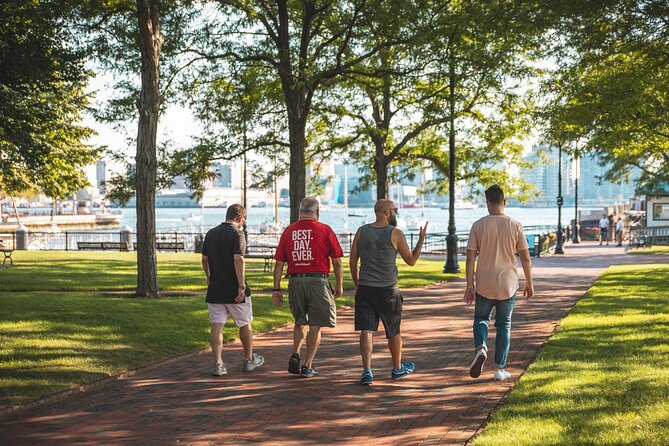
- Freedom Trail walking with built-in photo stops and context
- Harbor views plus working-port history at Independence Wharf, Boston Harborwalk, and Long Wharf
- Classic Boston food stops like Quincy Market and Faneuil Hall Marketplace
- Beacon Hill architecture and that red-brick, row-house feel
- Small group size (max 12), which makes it easier to ask questions
A walk where lobster rolls meet the Revolution
This is the kind of Boston tour I like: you’re moving through real neighborhoods, you’re eating real food, and the history doesn’t feel like a lecture. The structure is simple. You start near Boston Harbor, you work your way through the downtown history loop, and you finish near the Public Garden area. In between, you’re sampling New England staples that match what people actually ate along the coast and in the city.
What makes it work is the balance. You’ll get time for landmarks and photos, but you’re also always “doing something” with your senses—smelling seafood, comparing flavors, and learning why these places mattered. If you’re the type who likes to pair a meal with a map, you’ll enjoy the flow.
The guide component matters too. In past tours, guides like Tim have been called out for mixing history with a steady stream of answers and good energy. That’s important on a walking tour, because you’ll have plenty of questions, and you don’t want to feel rushed past the interesting parts.
You can also read our reviews of more walking tours in Boston


Independence Wharf: tea party views and the setup to revolution
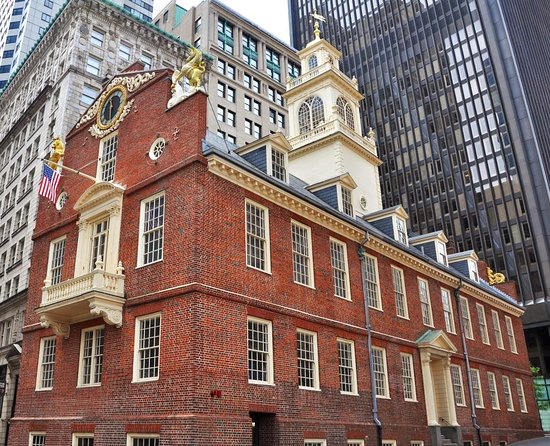
Your tour starts at 470 Atlantic Ave at Independence Wharf, with a prime opening look toward the Boston Tea Party Ship and Museum. Even if you don’t go inside, the setting gives you instant context. This is where the story of tensions leading to the American Revolution makes sense, because you’re standing in the waterfront zone where those events played out.
Your guide also points out landmarks like Fort Point and the Seaport District—a helpful reminder that Boston’s waterfront shifted from old-world commerce to modern neighborhoods. If you like to understand how a city repurposes space, this is a good first lesson.
Practical note: this first section is a great photo moment. You’ll be outside with harbor lines in view, and it’s the kind of shot you’ll be happy you didn’t skip.
Boston Harborwalk and Long Wharf: where trade shaped the city
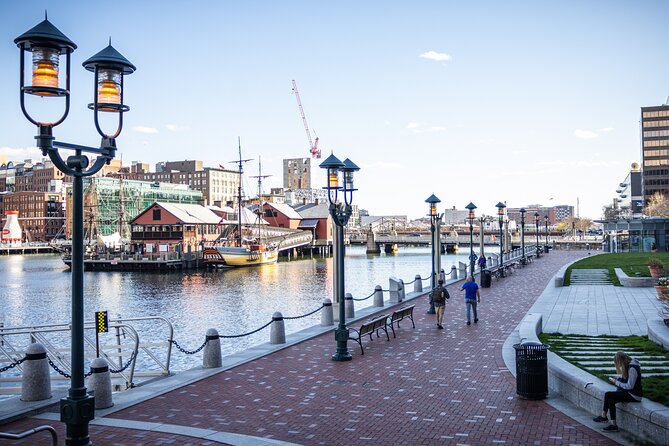
Next you move along the Boston Harborwalk, a pedestrian route that links harbor neighborhoods and keeps you close to the water. The value here isn’t just the scenery. It’s the way the guide connects what you’re seeing now with what the harbor did in the past.
Then you walk past Long Wharf, described as the first main port of Boston where goods came into the city for almost 200 years. That’s a big number, and the “why it matters” is the point. When you understand that this was the city’s shipping heartbeat, the later political story feels more grounded. People argue about independence, sure—but first they live inside an economy.
If you’re visiting in cooler months, this is also where the air can feel sharp off the water. Bring a layer you can manage for a long walking stretch.
Quincy Market and Faneuil Hall: eat first, then understand the speeches
At Quincy Market, you get a classic Boston stop with a lot going on: a well-known food hall plus shopping and entertainment. The tour uses this time as a breather and a reset. You can grab another angle on the city and get your bearings without feeling like you’re stuck in a line the whole time.
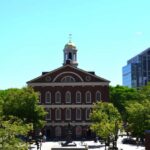
From there you head to Faneuil Hall Marketplace, often called the Cradle of Liberty. This is where the tour shifts from “things to see” into “why people cared.” Faneuil Hall wasn’t just a pretty meeting space. It played a major role in the Revolution era, and the building setting helps you imagine speeches and public momentum.
If you like history that has a street-level feel—people gathering, talking, organizing—this stop lands well. And if you’re a photo person, you’ll also have plenty of chances to capture the meeting-hall vibe from a few different perspectives.
Rose Fitzgerald Kennedy Greenway and State Street’s big-city clues

After the denser historic stops, you reach the Rose Fitzgerald Kennedy Greenway. It’s a public park section with green space and places to grab food nearby. For me, the value of this moment is simple: it gives you a pause without stopping the narrative. You still feel in the center of Boston, but you get a break from constant tight-city corners.
Then you head toward State Street and the Custom House Tower, Boston’s first skyscraper. That detail is easy to miss if you’re just walking on your own. On a guided route, it becomes a quick lesson: Boston’s story isn’t only about the Revolution. It’s also about how cities grow upward and modernize, and how older political roots sit right beside newer architecture.
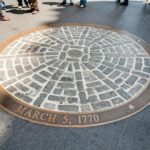
You’ll also stop in front of the Old State House and the site tied to the Boston Massacre story. The guide frames it with a critical question: was it truly a massacre, or did propaganda help shape the Revolutionary narrative? That kind of nuance is worth it. It turns a single landmark into a thinking exercise, not just a fact to memorize.






Downtown Crossing to Old City Hall: the bronze donkey moment
Next comes a short trek through Downtown Crossing, one of those places where you feel Boston as a working city—shopping, movement, people everywhere. It helps break up the timeline so the tour doesn’t feel like one long history march.
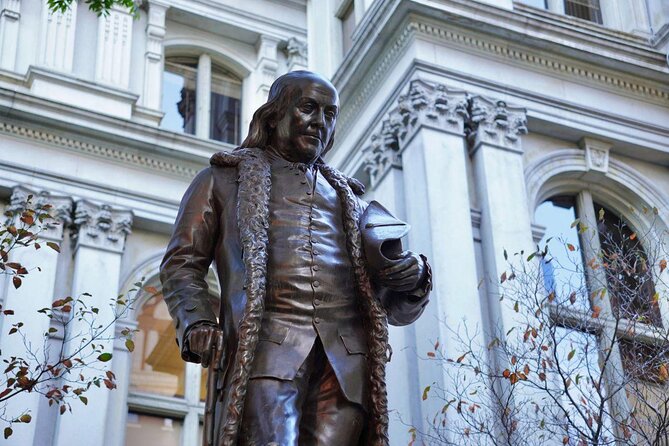
Then you reach Old City Hall, a standout stop if you care about architecture. It’s French Revivalist in style and it served as the seat of city government for years. The guide also highlights that it’s connected to the birth of public education in America. That’s a detail you might never catch on your own, and it broadens what you’re learning beyond politics alone.
And yes, you’ll want your camera ready for the bronze donkey outside the entrance, because your guide will snap your picture there. It’s one of those goofy-but-memorable moments that makes walking tours feel real instead of robotic.
Massachusetts State House: seeing government at work (when open)

On most weekdays, you might have a chance to see the Massachusetts State House when government hours allow. The building is inspiring, and it matters here that the guide connects design and purpose. You’ll hear that it was designed and built by Charles Bulfinch in 1798.
Even outside, you get context on modern Boston from the viewpoint: you’ll see the skyscrapers of Downtown and the Financial District, including the John Hancock Tower, which is identified as the tallest building in New England.
This stop is a good example of why the tour is more than a food crawl. You’re walking a line from revolutionary-era thinking to the actual institutions that grew out of it.
Beacon Hill: red brick row houses and that Boston look
As you continue into Beacon Hill, the tour slows down into a neighborhood experience. Beacon Hill is known for the look of its red brick row houses, and you’ll have time for photos and simply taking in the streetscape.
This is where you can switch modes mentally. After seafood and political landmarks, it’s a chance to observe how Boston lives today—what the city feels like when it’s not about protests and speeches.
If you’re a structure-and-street layout person, this section is satisfying. If you prefer to be indoors, bring a light plan for how you’ll warm up after the final walking stretch.
Price and value: why $172.33 can feel fair
At $172.33 per person, this isn’t a bargain-basement option. But it can feel like a good value because food is the main cost driver—and the tour includes a lot of it.
Here’s what you’re getting in plain terms:
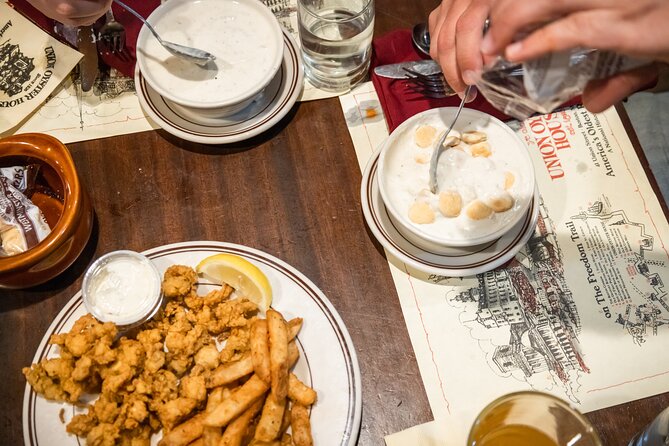
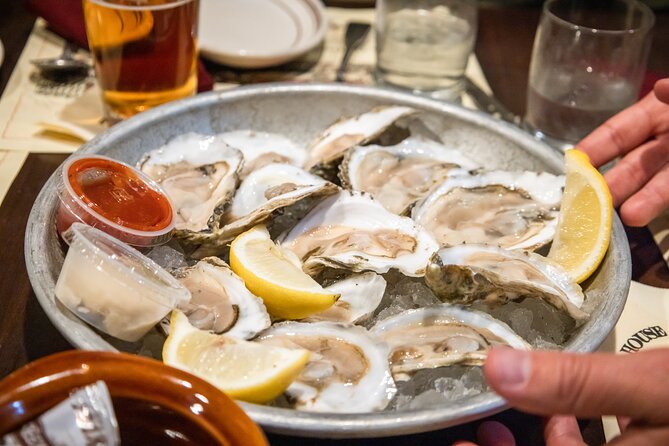
- A variety of seafood samples (the guide can serve classics like lobster roll and New England clam chowder, and it may include stuffed clams, quahogs, and even raw oysters)
- Enough sampling that the tour info describes the samples as totaling the equivalent of a full meal
- A surprise local treat
- Tips on where else to eat and see, plus guidance on responsibly sourced and sustainable seafood efforts
Food tours often disappoint because “sampling” ends up being two bites and a wander. This one is designed around shellfish-focused New England classics and emphasizes sustainable sourcing. That’s not just a feel-good message; it affects what you’re served and why you’re eating what you’re eating.
What you don’t get is also clear. Additional food and drink aren’t included, and you’ll be expected to handle tips/gratuities separately.
So if you’re hungry, eat seafood, and want a guided walk that covers more than one neighborhood, the price can make sense. If you’re a picky eater or you can’t do shellfish, it’s not the tour for you.
The walking pace, timing, and what to pack
The tour runs about 5 hours, starting at 1:00 pm. Expect roughly 5.6 km (2.5 miles) of walking. That’s not extreme, but it’s not a “stroll-only” plan either. It’s steady city walking with stops for eating and photos.
The tour also runs in rain, shine, or snow unless conditions become dangerous. Bring a rain layer if the forecast looks questionable. If it’s cold, wear shoes that work on slick sidewalks.
Good to know:
- Group size is capped at 12, which helps with pacing
- You use a mobile ticket
- It’s family-friendly, with children under 6 joining free
- Service animals are allowed, and it’s described as suitable for most fitness levels
If you get tired walking, you’ll want comfortable footwear more than anything else. Food does its part, but your legs still do the heavy lifting.
Who should book this seafood and Freedom Trail combo
This tour fits you best if you:
- Want Boston’s Freedom Trail story without reading a guidebook for every stop
- Like a meal format where you try multiple foods in one outing
- Enjoy photo stops at the harbor and downtown landmarks
- Prefer a small-group walk over a big bus tour
- Care about sustainably sourced seafood messaging while you eat
You should probably skip it if you:
- Have a shellfish allergy (no substitutions are available for shellfish-centered food)
- Don’t eat seafood at all, since the food plan is built around shellfish-heavy New England picks
Should you book the Boston Seafood & Freedom Trail Walking Tour?
I’d book it if you want one afternoon that covers both Boston’s “wow, look at that” moments and its “wait, that mattered” moments. The mix is smart: harbor views early, Revolutionary landmarks in the middle, and neighborhood architecture to close. Add seafood sampling that can reach full-meal territory, and you get a tour that saves time while still feeling personal.
If you’re sensitive to shellfish or you’d rather spend your time in a museum than on your feet, choose another Boston plan. But for most people who eat seafood and like guided walking, this is a strong pick—especially if you want a guide who can answer questions and keep history moving along with the food.